
Farm
Continuity Management
Keep the farm operating when normal conditions are disrupted, by protecting animal care, milk routines and recovery decisions.
UpstreamIntegratedMonitoring & Coordination

Service overview
Responsibility.
Every working day.
Keep the farm operating when normal conditions are disrupted. The service monitors operational risks, coordinates emergencies and utility outages, organizes production-recovery actions and, where required, temporary or relief management so animal care and essential milk-production routines continue through staff shortages, equipment failures or other serious interruptions.
The operating plan links operational risk monitoring, emergency coordination and utility-outage response. Records such as continuity plan and incident log make time to identify disruption and essential-task continuity visible in management review. The service agreement confirms coverage, handovers, exception ownership and the decisions that remain with the client. This creates one recurring line of responsibility from routine work through follow-up.
What this service
takes responsibility for
Lead emergency coordination
Maintain utility-outage response
Manage production recovery
Manage temporary management
When you may
need this service
Utility outages or equipment failures threaten essential farm routines
Key staff absence leaves animal care without cover
The farm has no tested recovery and escalation plan
A disruption has started and temporary management is needed
Operating
scope
Operational risk monitoring
Emergency coordination
Utility-outage response
Production recovery
Temporary management
Animal-care continuity
Operating model & service rhythm
Work with
a dependable rhythm.
Contingency routines are maintained continuously; incident coverage is agreed by scope. The agreed service arrangement defines responsibilities, coverage, site visits or remote coordination, handovers and exception escalation before work begins.
Controls & measures
Indicators describe what should be watched. Targets and response commitments are set in the agreement.
Key operating controls
- Identify essential animal-care and milk tasks
- Maintain contacts, backups and relief responsibilities
- Record incidents and the decisions made during response
- Track recovery of production and utility functions
- Review the event and update continuity arrangements
KPIs & service levels
- Time to identify disruption
- Essential-task continuity
- Recovery action completion
- Unresolved incident count
- Readiness of backup resources
Reporting &
deliverables
Farm Continuity Management
- Continuity plan
- Incident log
- Recovery record
- Relief-management handover
How the service
is delivered
- 01
Mobilize & Define Responsibility
Confirm assets, access, records, service levels, escalation and the starting condition.
- 02
Baseline & Plan
Set the operating baseline, schedules, resources, KPIs and control points.
- 03
Operate & Execute
Perform the recurring work in the agreed service scope.
- 04
Monitor & Control
Track condition, quality, productivity, alarms and exceptions.
- 05
Correct & Improve
Close deviations and adjust routines when evidence shows a better approach.
- 06
Report & Review
Issue records, discuss performance and update the next operating cycle.
What we need
from you
- Current procedures and records for operational risk monitoring.
- Access to the people, assets and data involved in emergency coordination.
- Known defects, unresolved incidents and the starting condition for this operating responsibility.
- Named client contacts, decision rights, coverage expectations and escalation contacts.
- Agreed indicators, reporting format and relevant supplier or specialist contacts.
Interfaces & boundaries
Advisory reviews the need and Engineering defines approved changes; Operations carries the recurring responsibility for operational risk monitoring.
Implementation commissions or rolls out a changed system; Operations takes over emergency coordination after an agreed handover.
Supply provides specified equipment and inputs, while Development addresses new capabilities. This service manages routine utility-outage response.
OperationsFarm Continuity Management
Dairy Grid: Where This Operations Service Is Used
Grid level · Business / unit
- A Family Farm — used
- Standard Family Dairy Farm Unit
- B Village Center — not used
- C Municipality Center — not used
- D Province Hub — not used
- E Country-HQ — not used
Role in the Grid
Farm Continuity Management supports the Family Dairy Farm Unit through recurring operational risk monitoring and emergency coordination.
Network value
Shared operating records and review of time to identify disruption help the network keep this responsibility consistent and visible.
Embedded delivery. Within Dairy Grid, this capability is embedded in the relevant Unit/Package or network operating model and is not promoted as a separate add-on to members.
Work with GEO Dairy on this service
Qualified operators.
Defined responsibility.
- Dairy farm managers
- Farm technical coordinators
- Maintenance providers
- Farm data and back-office specialists
Relevant authorization where applicable, dairy or food references, team depth, geographic coverage, response capability, safety and quality systems, and reporting evidence are reviewed. Registration does not guarantee assignment.
Discuss an operating partnershipConnected services
 01Operations service
Farm Technical Coordination
Coordinate the farm's recurring technical work across utilities, milking, feeding, environmental systems and other equipment. Work orders, preventive and corrective maintenance, critical spare parts, suppliers and utility-downtime response are organized through one technical-control function so maintenance priorities and external service providers do not compete or leave interface gaps.
View service 02Advisory service
Dairy Farm Performance Assessment
Review whole-farm technical performance to identify the highest-value opportunities in herd, feeding, milk, health and facilities.
View service 03Development service
Dairy Farm Development
Develop a new dairy-farm business from an investable concept into an implementation-ready operating capability. The program connects greenfield farm development, investment preparation and technical development so herd size, facilities, utilities, equipment, operating model and startup needs mature together instead of being planned as unrelated workstreams.
View service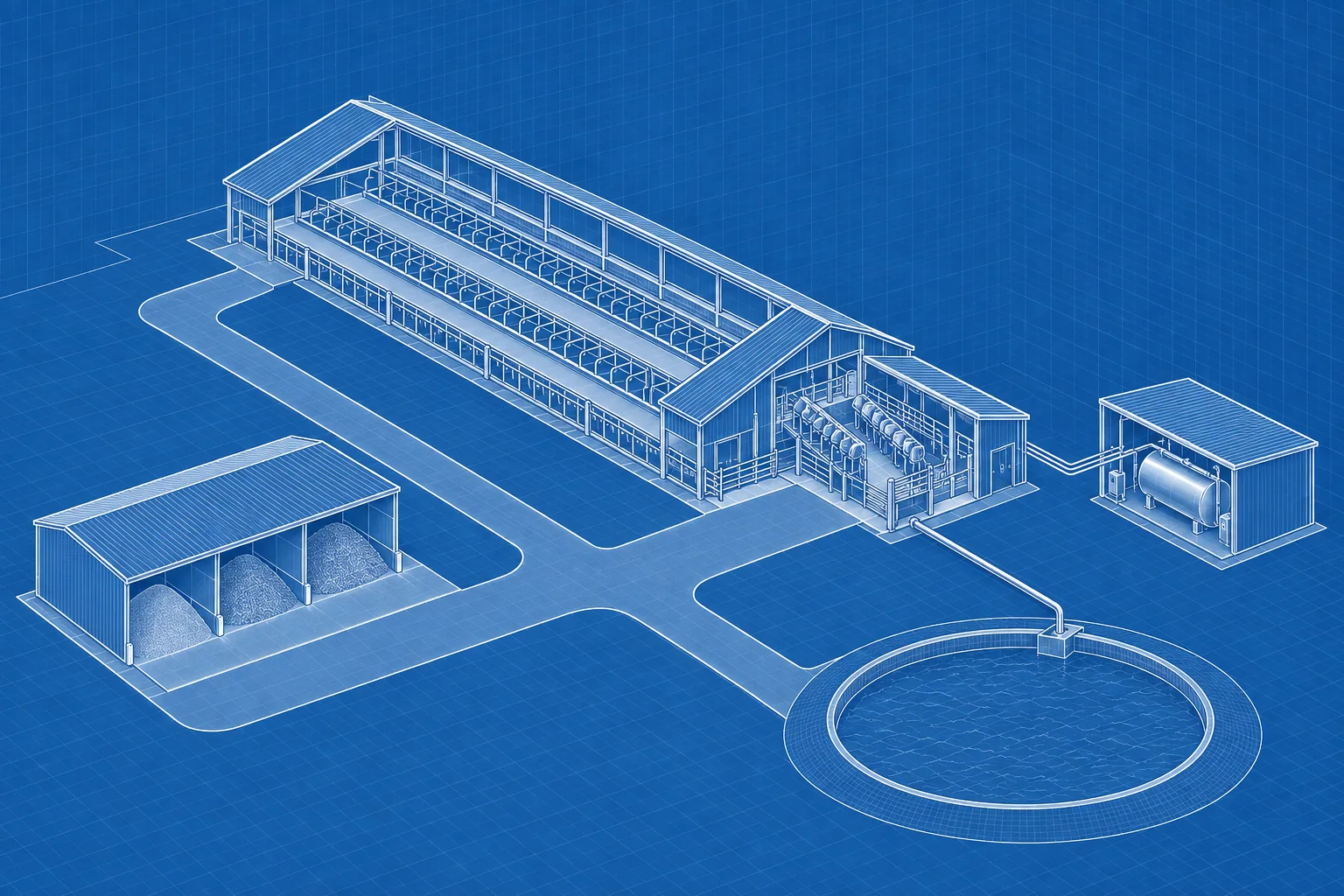 04Engineering service
Dairy Farm Design
Design a complete dairy farm as one coordinated operating system, aligning capacity and process flow with the interfaces between facilities, utilities, herd handling, feeding, milk systems and environmental systems. The service establishes the technical basis, equipment/infrastructure schedules and specifications needed to move a farm project toward procurement and implementation.
View service