
Farmers & Family Businesses
People who own or operate dairy farms.
Find a path for this roleBuilding the people who build the dairy industry.
Dairy Academy is GEO Dairy’s professional learning and capability-development program for dairy. It connects scientific knowledge, practical experience, modern technology and real dairy businesses to help people develop the skills required across farming, processing, distribution and the wider dairy ecosystem.
From a Family Farm operator learning herd management to a processing technician mastering CIP, a veterinarian developing dairy specialization or a manager preparing to lead a dairy business, Dairy Academy is designed around the real roles that make the industry work.
Equipment = performance ?
Equipment + capable people = performance
A modern farm can buy sophisticated milking equipment and still perform poorly. A dairy plant can install an advanced processing line and still struggle with quality, maintenance or yield. The difference is often the capability of the people operating the system.
Dairy modernization therefore requires investment in two forms of capital: physical capital and human capability.
Dairy Academy exists to make professional dairy knowledge more accessible, practical and connected to real businesses.

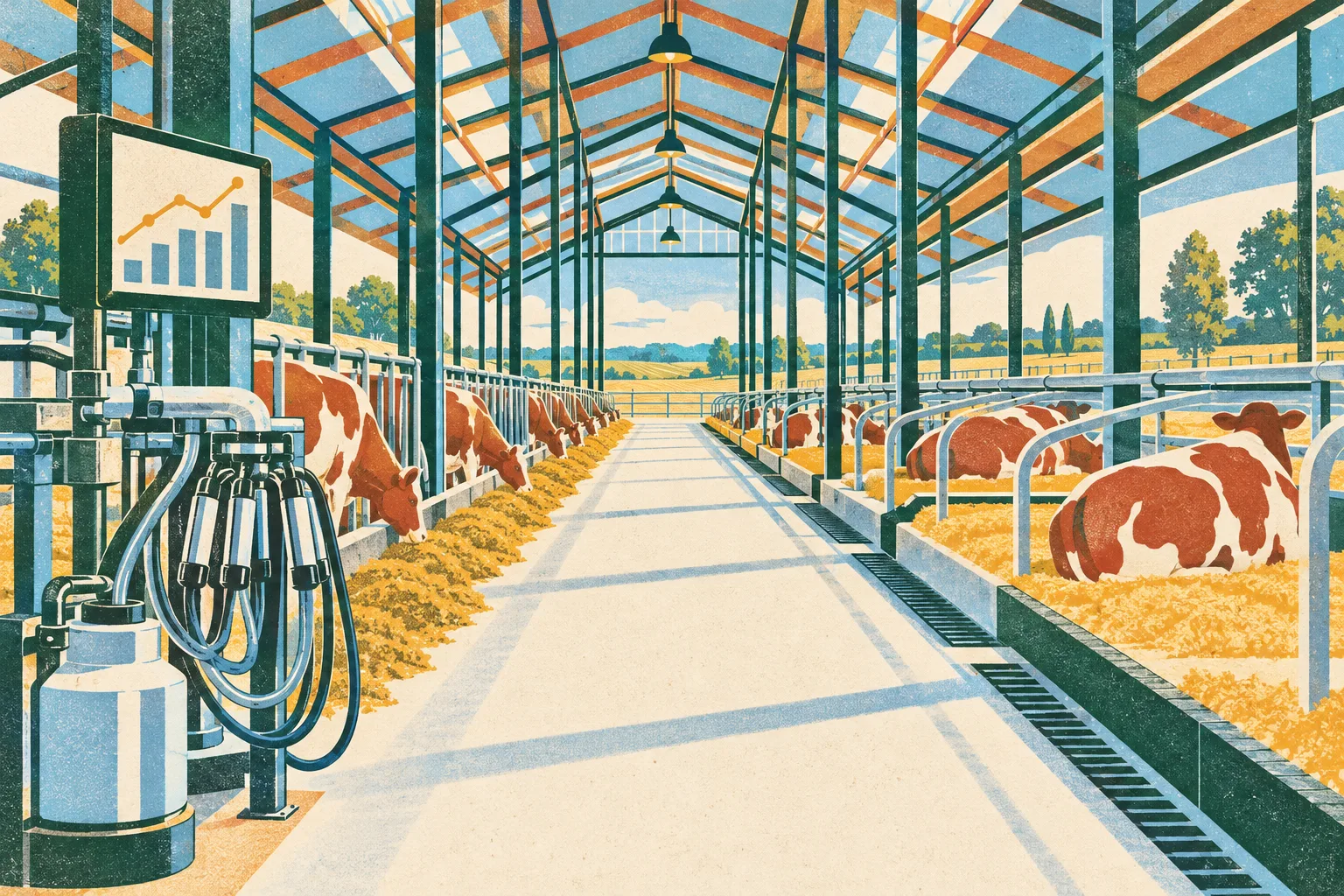
Same barn, same equipment. Drag the handle. Illustrative.
Dairy Academy follows the same value chain as the industry itself. Ride a line to meet the people who keep it running.
Farmers · Herd Managers · Veterinarians · AI Technicians · Nutritionists · Milking Staff · Farm Technicians
Dairy Academy is a structured platform through which GEO Dairy can organize, curate, develop and connect dairy education and professional learning. Its activities may include fifteen formats.
The Academy can deliver learning directly where GEO Dairy has the required capability or work with qualified external instructors, universities, vocational institutions, technology companies and industry experts.
Dairy Academy should not automatically be described as:
Where a course requires an officially recognized qualification, professional license or accredited certificate, Dairy Academy should work through appropriately authorized institutions or clearly state the status of the qualification.
A course-completion certificate is not the same as a regulated professional qualification.
 Participation
Attended a learning activity.
 Completion
Completed specified curriculum/assessment.
 Competency Record
Demonstrated a defined practical capability.
 Partner / Accredited Qualification
Issued through an authorized institution where formal recognition applies.
To develop the knowledge, practical skills and professional capability needed to build and operate modern dairy businesses across the complete value chain.
This includes capability for individuals and organizations, and ultimately strengthens the national dairy ecosystem.
People gain knowledge and practical skill.
The Academy serves ten distinct audiences, each with its own reasons to learn. The wall shows how much of each competency a typical starting point carries. Pick a column. Illustrative profiles.
People who own or operate dairy farms.
Find a path for this roleA six-level learning architecture gives the Academy a recognizable progression without pretending every profession follows the same qualification framework.

Understand the dairy industry and career/business opportunities
A milker does not need isolated courses called “Vacuum,” “Udder,” “Chemicals,” “Data.” The person needs a coherent learning path for the whole job: the Milking Operator.
Academy programs should be designed around the work people need to perform, while the underlying curriculum remains connected to GEO Dairy’s technical taxonomy.
For public navigation, Academy content is organized around three obvious schools, plus two cross-value-chain schools. This is easier for learners than exposing the full taxonomy immediately.
Upstream
The curriculum follows the approved Upstream domains: Facilities, Utilities, Herd, Breeding, Health, Nutrition, Milk, Environment and Integrated. Open a domain’s door to see the programs behind it.
One of Dairy Academy’s flagship programs: thirteen modules, in order. Completion could become part of readiness to operate a Dairy Grid Family Farm.


0 / 13 stamped
 Ready to operate a Dairy Grid Family Farm
Each Upstream specialism has its own program set. Choose one and see where on the animal it begins.

Programs teach participants not merely to observe cows but to make decisions from herd data.
The curriculum follows nine domains. Follow the milk through the plant and the programs that belong to each stage light up. Eighteen potential programs.
Role-based programs for the people who make dairy products. Open a drawer in the training archive.
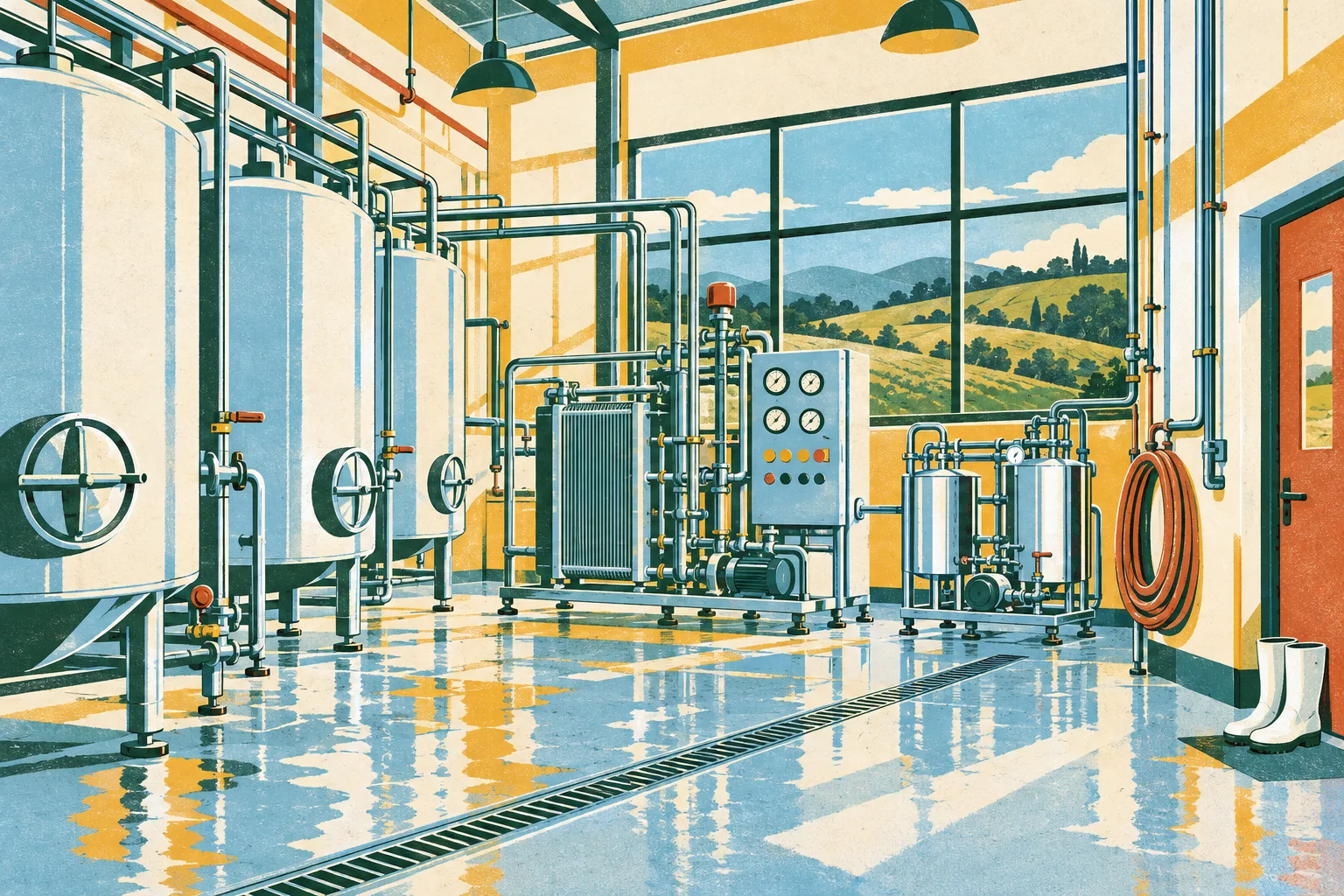
A good operator should understand both how to operate and why the critical parameters matter.

Five levels: Introduction (milk, coagulation, whey, salt and cheese families), Practical Cheesemaking (cultures, enzymes, cutting, draining, molding, salting), Advanced (yield, microbiology, maturation, defects, process control), Traditional Georgian Cheese and Commercial Cheese Production. This could connect with Dairy Award later.

Programs around starter cultures, milk preparation, yogurt, kefir, fermentation temperature, texture, flavor, contamination, cooling, filling and shelf life.

This should serve operators, laboratory staff and managers at different levels.

This could materially improve dairy-processing professionalism.

OEM partners can participate in equipment-specific training.
The curriculum follows Facilities, Channels, Commercial, Logistics, Fulfillment and Integrated. The board shows fifteen potential programs as shipments from plant to customer.

Cold chain, warehouse teams, drivers, distributors and retailers are part of the curriculum, not only refrigeration engineers.
Existing farms and plants may use Academy programs for onboarding, refresher training, equipment startup, quality improvement, management development, corrective training and new technology. Training should follow a diagnosed capability gap rather than being prescribed automatically for every performance problem.

Presenting problemMastitis cases are rising and the milk-quality bonus is at risk.
Skills gap: the milking routine is not followed consistently. Equipment and procedure are sound.
Presenting problemYield drops after changeovers because steps are skipped.
Skills and process: operators lack changeover practice and the SOP is unclear.

Presenting problemYogurt returns rise: the cold chain breaks at handover.
Skills gap: handling teams do not follow handover practice. Trucks and stores are working.
Presenting problemA filler stops three times a week and output is lost.
Equipment fault: a worn part causes the stops. Operators follow the procedure correctly.
Dairy Academy can provide the platform, while extensive customized design may be delivered through GEO Dairy Development services.
Dairy business models, planning, CAPEX, OPEX, cash flow, farm and processing economics, unit economics, finance, investment, procurement, contracts, risk, insurance and management. Move the three levers and read the margin.
A teaching model, not financial data.
 Dairy Business Academy
Distinct versions for Family Farms, Feed Businesses, Processing Plants, Distribution Businesses and Investors.
Manager DevelopmentA capable technician is not automatically a capable manager. The Academy should deliberately develop both.
 Investor Education
Understand the main biological, operational and financial drivers well enough to evaluate performance and management decisions.
The Academy’s cross-value-chain school. Step into the control room and pick a screen.
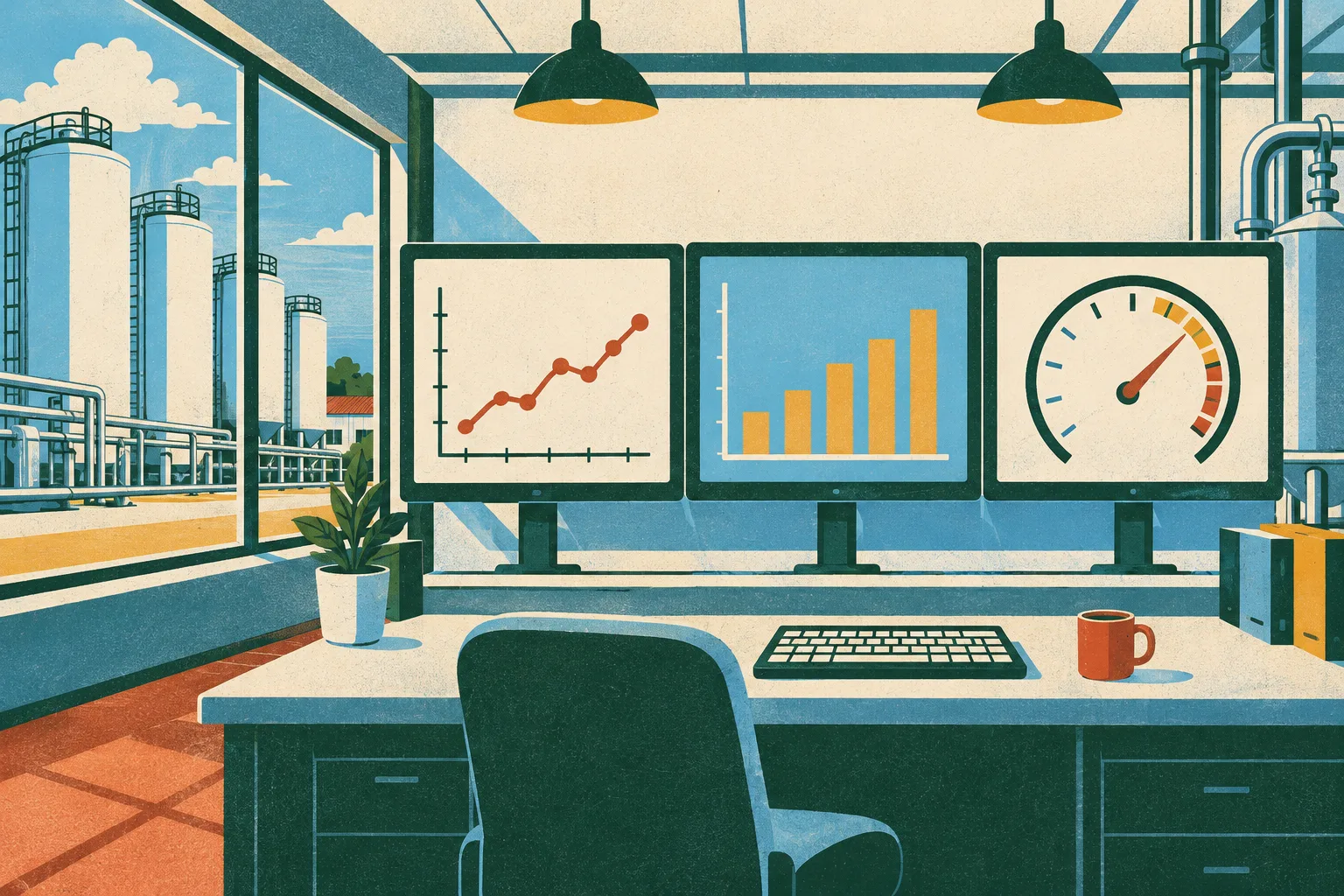
Use the technology correctly, understand the data and act on it.
Safety content should be role- and jurisdiction-appropriate. Possible subjects: machinery safety, animal handling, chemicals, confined spaces, electricity, hot surfaces, pressure systems, refrigeration risks, lifting, ppe, emergency response.
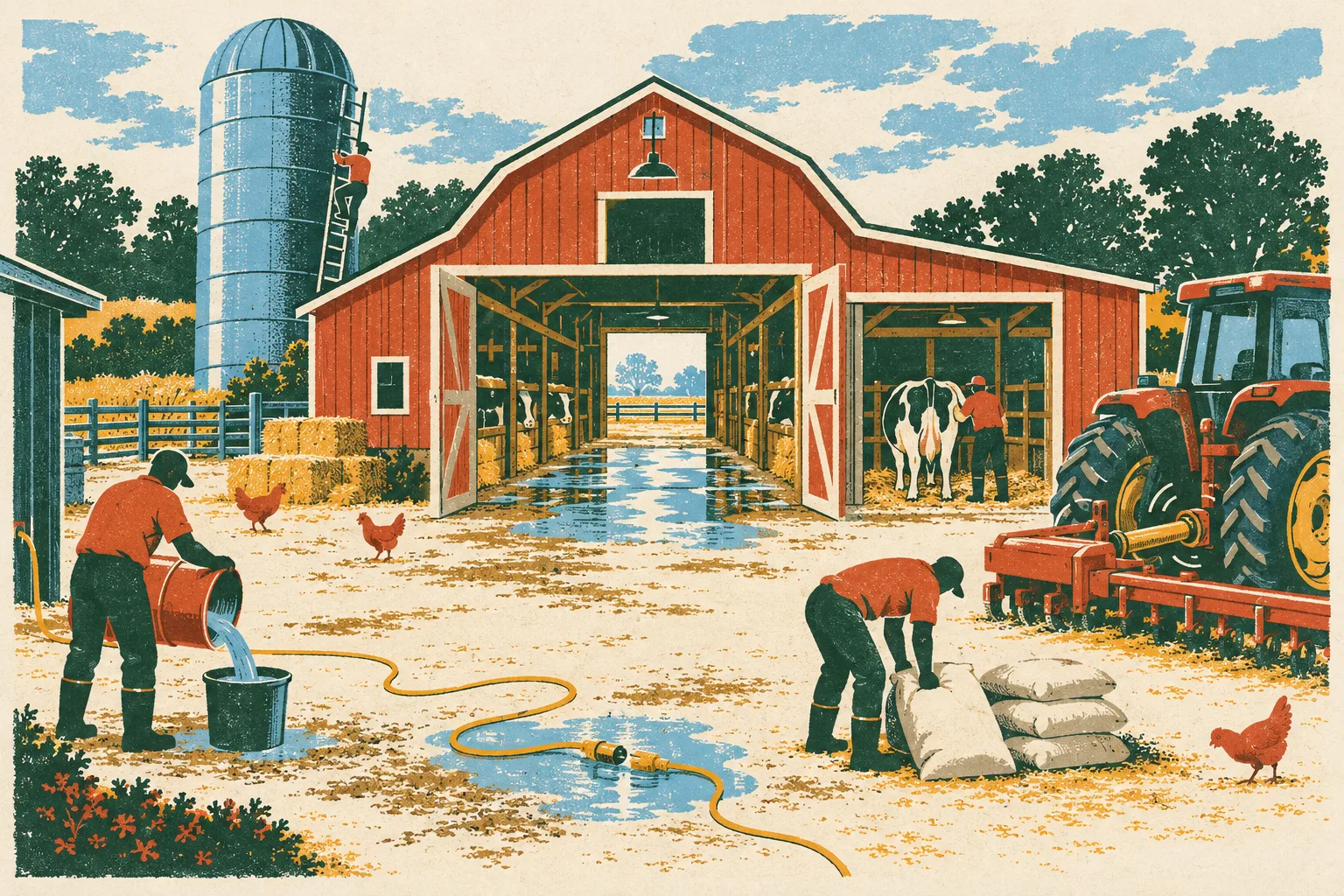
Dairy Academy should intentionally combine theory, demonstration, practice, assessment and workplace application. Learning environments may include operating farms, Dairy Grid units, processing plants, laboratories, workshops, demonstration equipment and partner facilities. Where practical skill is the objective, practical assessment should matter.
Why it works: the principle, explained at the board.
Dairy Grid could become one of Dairy Academy’s strongest learning assets. It can provide real environments for farm operator training, veterinary practice, feed-center training, calf care, milk-quality training, equipment maintenance, digital-system use, processing and logistics.
The Academy can learn from the Grid while helping the Grid improve.
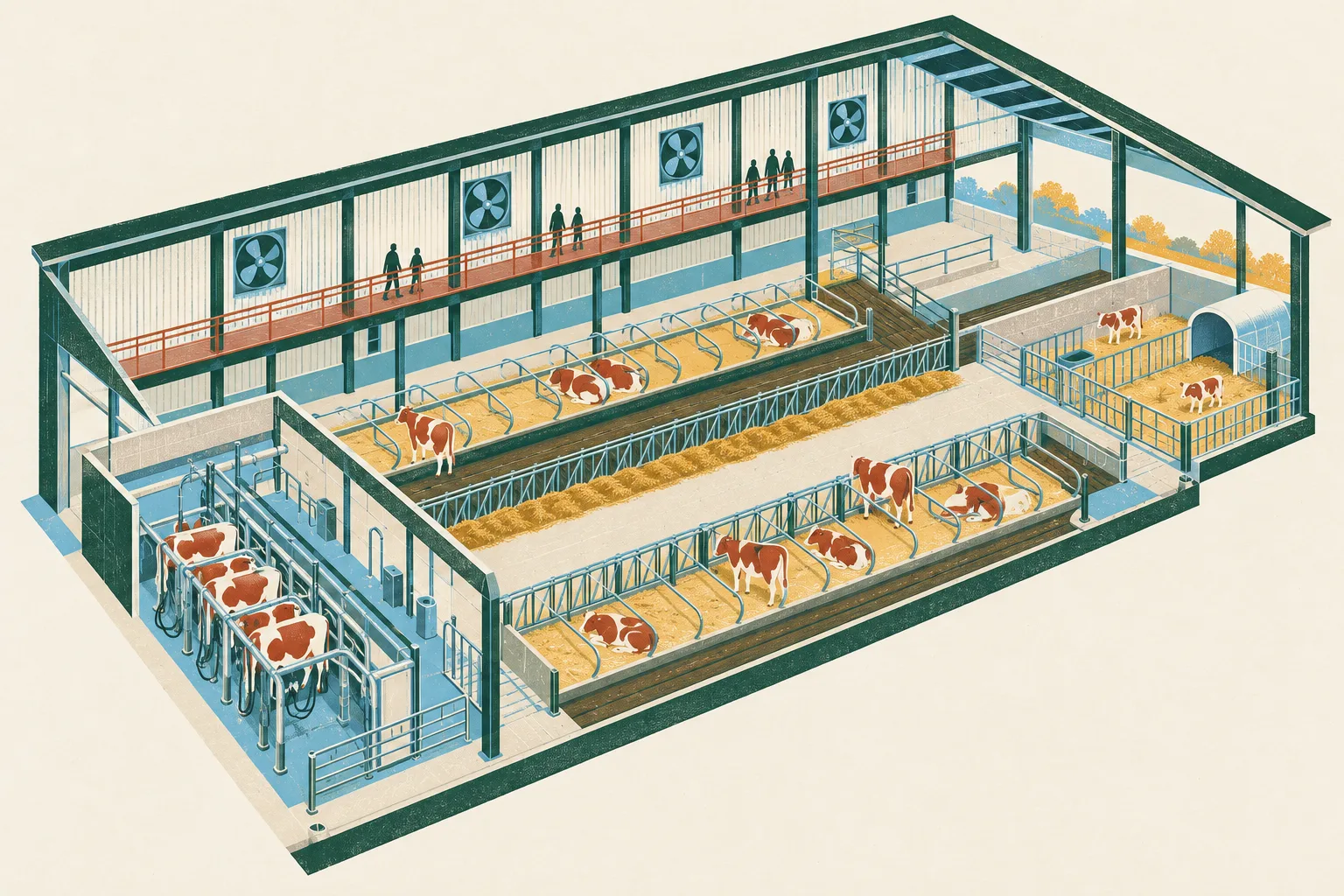
Demonstration farms & facilities: barn systems, milking, ventilation, feeding, calf management, manure systems, processing, CIP and cold chain.

Theory, demonstration and practice beside real animals and equipment.

Demonstration sites, placement hosts, practical training sites and field-day hosts, qualified for safety and suitability before use.
Four ways the Academy meets people where they work. Choose a format and the phone shows it.
 ▶

Dated, versioned, reviewed.
Meaning and practice, not literal translation.
Video lessons, interactive modules, recorded lectures, assessments, technical references, SOP learning, dashboards and learning records. Online learning is particularly useful for theory, refresher training and distributed participants, but should not replace necessary hands-on training.
The assessment method should match the learning objective. A milking procedure is better assessed through observed practice than through a multiple-choice test alone.
Which method proves it?
| Course | Assessment | Result | Validity |
|---|---|---|---|
| Milking routine | Practical · observed | Competent | Valid to 2027-03 |
| Mastitis awareness | Quiz · 92% | Passed | Valid to 2026-11 |
| Farm biosecurity | Completed | Completed | Refresh due |
| Calf management | In progress · 3 of 5 | In progress |
Dates, results, practical assessments, validity or refresh periods, trainer and required next learning. For Dairy Grid, this can support workforce readiness and role authorization.
Recurring learning for veterinarians, engineers, technicians, managers, quality specialists and trainers builds a learning history over time. Illustrative.
A national network cannot depend on a few central instructors forever. A Train-the-Trainer system develops people who understand technical content, adult learning, demonstrations, assessment, safety and standardized materials, so knowledge can scale while staying consistent.



Pick a candidate and press Qualify.
Illustrative scale.
Manufacturers can teach their technology within a controlled framework: commercial promotion is distinguishable from independent professional education. Example titles for illustration.
Potential partners include universities, vocational institutions, research institutes, veterinary organizations, laboratories, equipment manufacturers, dairy processors, commercial farms, international experts, public agencies and development organizations. Add them to the network.
Click a partner to connect it. 0 of 11 connected.
 Internships & Apprenticeships
Create a route into the industry: learning, supervised work and assessment for students, young technicians, farm managers, processing operators and veterinarians.
 Vocational partnerships
Dairy Academy can help define the dairy-specific competency component around broader technical qualifications.
 University partnerships
Bridge research to industry application and industry problems to research questions.
People are more likely to enter an industry when they can see a professional future inside it.
Step 1 of 5. Pathways are examples.
Dairy Academy develops capability. Supply → Workforce provides access to people. A company might recruit through Workforce, train through Dairy Academy and manage recurring work through Operations.
Which door does this request go through? Tap a request, then a door.
Academy builds skills. Workforce supplies people. Operations supplies recurring performance.
Grid builds production. Academy builds capability. Market builds commercial connection. Award recognizes excellence.
The Academy develops the knowledge, practical skills and professional capability behind every other program.
OpenA public calendar can filter by Upstream, Midstream, Downstream, Business, Technology, beginner or advanced, online or in-person, Georgian or English, region and audience. It should become a functional part of the Academy rather than a static webpage section. The Academy can also host research presentations, innovation days, technical forums, field trials, new-product demonstrations and technology workshops, to accelerate knowledge, evaluation and appropriate adoption.
Pick an event to see its format.
The Academy has its own Navigator branch. Two questions are enough to recommend a first route, so it feels like a structured development system rather than a course catalogue.
Every Academy resource should carry its owner and its review date. Content relating to regulation, animal health, food safety, equipment, medicines and technology may require more frequent review. No course should become permanent simply because it was created once.
“Learn about milk quality.”
“After completing this module, the participant should be able to identify the principal causes of milk-quality deterioration, perform the required daily checks and escalate abnormalities correctly.”
Clear outcomes improve course design, assessment and employer confidence.
Not when classroom seats are full. Indicators go beyond attendance: reach, completion, competence, business impact and career impact.
Gauges are illustrative.
 Free public knowledge
 Sponsored learningParticipant-funded coursesEmployer-funded trainingDairy Grid embedded training
 Partner-supported programsScholarship-supported learning
Scholarships may target rural youth, veterinary specialization, technicians, outstanding students and strategic skill shortages. Availability should only be promoted where actual funding exists, and none is promoted today.
Dairy careers increasingly involve biology, automation, engineering, data, food technology, logistics and business management. Dairy Academy can help younger people see the industry as a professional career environment rather than only traditional agricultural labor.
Four ways to take part beyond being a learner. Notes on the notice board are pinned as the network grows.
Partner With Dairy AcademyUniversities, vocational institutions, laboratories, manufacturers and public agencies.
In preparationBecome an InstructorShare professional capability: expertise, professional background, courses proposed, practical experience, languages, location, teaching experience, references and availability. This belongs to the provider side of GEO Dairy Navigator.
In preparationHost Academy TrainingFarms, factories, laboratories and technology centers may eventually be demonstration sites, placement hosts, practical training sites and field-day hosts.
In preparationKnowledge CommunityLater, a professional community to follow updates, attend events, access resources and connect with specialists, with moderation and technical governance.
In preparationTen pathways into the Academy. Start from where you are, not from a course list. Pull a book from the shelf.
Start in DairyBuild foundational knowledge.
Find my pathGrid builds production. Academy builds capability. Market builds commercial connection. Award recognizes excellence.
 01Dairy Grid
Build connected dairy businesses.
Open02Dairy AcademyBuild the people and capability behind them.
You are here 03Dairy Market
Connect production with professional demand.
Open 04Dairy Award
Recognize excellence and contribution.
OpenBuildings, animals, machinery and software can be purchased. Capability must be developed.
Dairy Academy is designed to connect knowledge with practice so farmers, veterinarians, technicians, processors, managers and other professionals can perform their roles with greater confidence, consistency and technical understanding.
By developing people alongside physical investment, GEO Dairy aims to build an industry capable not only of adopting modern systems, but of operating and improving them over time.