

Product moves forwardInformation moves back
DownstreamDairy Industry
From the finished dairy product to the customer, the consumer, and the responsible management of what remains afterward.
Downstream begins when a finished dairy product has been manufactured, packaged and released for commercial distribution. It connects that product with wholesalers, distributors, retailers, foodservice operators, institutions, digital channels and final consumers through commercial strategy, logistics and fulfillment.
GEO Dairy also recognizes the post-consumption interface: returns, expired products, food waste, used packaging, recycling systems and the environmental and social responsibilities surrounding the product after sale.

The Market-Facing Stage of the Dairy Value Chain
Downstream covers the systems required to move a finished dairy product from the end of manufacturing into the market and ultimately into use or consumption.
It therefore combines physical movement, commercial relationships, customer access, order execution and post-consumption responsibility.
- Physical movement
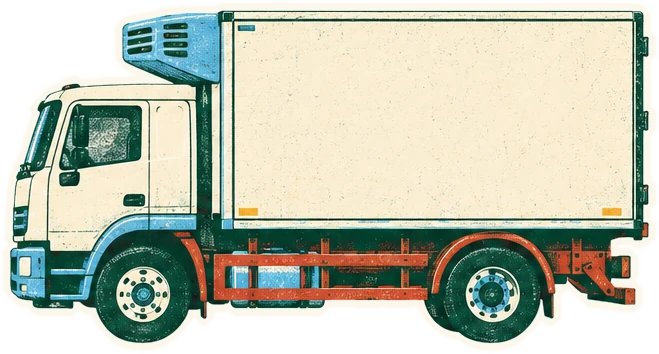
- Warehouses, cold chain, trucks.
- Commercial relationships
- Contracts, trade terms, key accounts.
- Customer access
- The channels that reach buyers.
- Order execution
- From order to complete delivery.
- Post-consumption responsibility
- Returns, waste, packaging, recycling.
- One market-facing stage
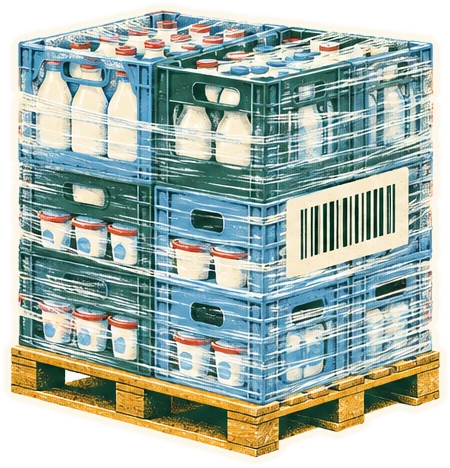
The Finished Product Handover
For GEO Dairy, Downstream begins when a packaged dairy product has completed Midstream production, passed the required quality-release process and is ready to enter commercial inventory or distribution. The handover typically occurs after processing, packaging, coding, production quality release and plant-side completion.
From that point the core questions change: from how do we manufacture it? to where should it go, who should buy it, at what price, through which channel, and how will it be delivered?
Midstream creates the product. Downstream creates market availability.
- Processing complete
- Packaging complete
- Coding applied
- Quality release passed
- Plant-side completion
- How do we manufacture it?
- Where should it go? Who should buy it, at what price, through which channel? How will it be delivered?
Consumption Is Not Always the Final Interface
The core Downstream stage extends through commercial delivery, customer fulfillment and final consumption or use. GEO Dairy also includes the immediate post-consumption interface where commercial responsibility continues: product returns, recalls, expired goods, reusable assets, package recovery and recycling arrangements.
Actual recycling or waste-processing operations may belong to specialized recycling, municipal or environmental industries rather than to the dairy industry itself.
GEO Dairy’s Downstream role is designing, coordinating and managing the dairy industry’s interface with those systems, not redefining recycling plants as dairy businesses.
- Core Downstream
- Commercial delivery · customer fulfillment · final consumption or use.
- Post-consumption interface
- Returns · recalls · expired goods · reusable assets · package recovery · recycling arrangements.
- Specialized industries
- Recycling plants · municipal systems · environmental industries. GEO Dairy designs and coordinates the interface, not these plants.
The Complete Downstream Journey
Thirteen steps, from the finished product to the recycling interface. This makes Downstream visibly broader than logistics.
- Finished product
- Warehousing
- Distribution
- Channel
- Sales
- Order
- Fulfillment
- Delivery
- Customer
- Consumption
- Return or waste
- Packaging recovery
- Recycling interface
Access · Demand · Execution · Movement
GEO Dairy’s taxonomy is especially clear here. Four questions, supported by a fifth domain that holds them all.
Channels creates access. Commercial wins the order. Fulfillment orchestrates the order. Logistics moves the goods.
Facilities supports all four: where do these activities physically happen?
- channels
- Access
- Channels
- creates access
- commercial
- Demand
- Commercial
- wins the order
- fulfillment
- Execution
- Fulfillment
- orchestrates the order
- logistics
- Movement
- Logistics
- moves the goods
- Facilities
- where it all physically happens
- Finished dairy products
- Released from Midstream with a defined specification and shelf life.
- Facilities and cold-chain assets
- Cold stores, distribution centers, racks, docks, display cabinets.
- Vehicles and handling equipment
- Refrigerated transport, pallets, crates, loading equipment.
- Customers and channels
- The accounts, routes and partners that buy.
- Orders and demand information
- Forecasts, orders, prices and market signals.
- People, systems and capital
- Sales, warehouse and delivery teams; digital systems; working capital.
What the Market System Needs
Downstream consumes or depends on six kinds of input. Pull a layer out of the stack to see what it holds.
More Than Sales Revenue
Downstream produces five kinds of outcome, forward and backward.
Modern Downstream sends critical information back toward Midstream and Upstream.
- Customer delivery
- Complete, on-time delivery in the right condition.
- Revenue and market presence
- Sales, margin and a visible position on the shelf.
- Customer and consumer data
- What sells, where, at what price. Travels back.
- Recovered products and materials
- Returns, packaging and assets brought back into use.
- Social and environmental value
- Food access, jobs, less waste.
Six Technical Domains
GEO Dairy’s Downstream taxonomy is controlled and identical across the website, portfolio, Navigator and CMS. There is deliberately no separate Downstream Environment domain: environmental and social responsibilities are horizontal considerations applied across the domains.

D01Facilities
Facilities covers the physical environments required for downstream storage, commercial handling, distribution and customer-facing operations.
- Distribution centers
- Finished-goods warehouses
- Cold stores
- Cross-docking facilities
- Retail stores
- Dairy shops
- E-commerce fulfillment facilities
- Wholesale depots
- Delivery bases
- Return-handling areas
Downstream facilities should be designed around product flow, cold-chain integrity, picking efficiency, transport access, food safety and customer service. A commercial warehouse is not simply “storage.”
It is a node in the customer-delivery system.
- An illustrated cold-store warehouse with pallet racks, a forklift, a cold-room door and a refrigerated truck at the dock.
- Dock doors
- Where cold product changes hands without breaking the chain.
- Cold room
- Product waits at its storage temperature, by batch.
- Picking area
- Mixed cases are assembled to each order.
- Returns area
- Returned goods are segregated and recorded.
- Delivery bay
- Routes are loaded in delivery sequence.

D02Channels
Channels covers the market routes through which dairy products become accessible to buyers and consumers.
A channel is not the same as a customer. It is the commercial route through which customers are reached. Channels answers:
Where will the product be available?
- An illustrated high street with a supermarket, a corner shop, a cafe and hotel, a school, an online store with a scooter and parcels, and a farm shop.
- Supermarket
- Listing, shelf space and promotion decide the sale.
- Corner shop
- Small orders, high frequency, close to the customer.
- Cafe and hotel
- Café & hotel
- Foodservice packs, steady supply, account management.
- School
- Tender-based, predictable, high volume.
- Online store
- Digital access, physical cold-chain delivery.
- Farm shop
- Direct relationship and a story to tell.

D03Commercial
Commercial covers the market-facing activities required to create demand, secure sales and manage commercial relationships.
Product positioning · pricing · sales · key-account management · marketing · promotions · trade terms · merchandising · category management · customer acquisition · brand execution · commercial analytics
Commercial converts product availability into economic demand. A product may exist in a channel but still fail. Switch each reason on to see what it does to orders.
Channels gives access. Commercial converts access into orders.
- Listed
- Seen
- Chosen
- Ordered
- Reordered
- Wrong price
- Weak positioning
- Poor shelf placement
- No promotion
- Frequent stock-outs
- orders per 100 listings in a healthy base case
D04Logistics
Logistics covers the physical storage and movement of finished dairy products and related downstream materials.
Warehousing · cold storage · inventory movement · refrigerated transport · route planning · fleet management · cross-docking · loading · unloading · pallet management · reverse logistics
Logistics answers the physical question: how does the product get from one location to another in the required condition and within the required time? For dairy, temperature and shelf life make logistics especially important.
- Factory
- Hub A
- Hub B
- Store

D05Fulfillment
Fulfillment covers the coordination required to convert an order into a complete customer outcome.
Order capture · inventory allocation · picking · packing · dispatch coordination · delivery scheduling · proof of delivery · substitutions · short shipments · returns · claims · customer-service resolution
Fulfillment is broader than transport. A truck can arrive on time while the order is still wrong. Fulfillment answers: did the customer receive what was promised? This is why it is separate from Logistics.
- Whole milk 1L
- Yogurt 400g
- Cheese 200g
- Butter 250g
- Substituted: 10 × Butter 200g
DXIntegrated
Integrated applies when several Downstream domains must be coordinated as one commercial-distribution system.
Integrated is not a miscellaneous category. It is the composition layer for multi-domain downstream systems.
- Facilities
- Channels
- Commercial
- Logistics
- Fulfillment

Environment Is a Horizontal Responsibility Here
In Upstream and Midstream, manure, wastewater and industrial effluent are distinct technical systems requiring dedicated engineering. In Downstream, environmental impacts are embedded across other activities, so GEO Dairy treats them as horizontal ESG considerations. When several environmental actions must be coordinated across the chain, the correct classification may be Downstream → Integrated.
- Facilities
- Energy, refrigerants, building efficiency.
- Channels
- Fair access, local retailers, rural reach.
- Commercial
- Truthful claims, responsible marketing.
- Logistics
- Route efficiency, low-emission fleets, cold energy.
- Fulfillment
- Returns, packaging, order accuracy.
- Horizontal ESG consideration. Coordinated across several domains? Classify as Downstream → Integrated.

Downstream Begins With a Defined Product
Before distribution begins, the product already has a specification, packaging, weight or volume, shelf life, storage temperature, coding, brand, unit configuration and case configuration. Downstream must work within those constraints. A fresh yogurt with a short shelf life requires a very different system from a long-life UHT product.
Product design determines part of the downstream business model.
- Fresh yogurt
- Specification
- 3.2% fat, live cultures
- Packaging
- 400 g cup, foil lid
- Shelf life
- 21 days
- Storage
- 2–6 °C throughout
- Coding
- Batch + use-by on lid
- Case
- 12 cups, 120 cases per pallet
- High-frequency, short-chain, cold-controlled distribution.
- UHT milk
- Long-life, ambient stable
- 1 L carton
- Months
- Ambient until opened
- Batch + best-before on pack
- 12 cartons per case
- Longer-chain, ambient, lower-frequency distribution.

Time Is an Economic Resource
Every day of shelf life has commercial value. Manufacturing time, warehouse time, transport time, store inventory and consumer use all consume part of the product’s usable life. If too much is consumed before purchase, the result may be discounting, returns, food waste and a poor customer experience. Downstream should measure remaining shelf life, not only delivery time.
- Plant to DC
- In the DC
- DC to store
- In the store

Temperature Control From Factory to Consumer
Factory → cold store → refrigerated vehicle → distribution center → retail cold room → refrigerated display → consumer.
The cold chain is only as strong as its weakest uncontrolled point.
Digital temperature monitoring can increasingly provide continuous visibility rather than relying only on occasional manual checks.
- Factory
- Cold store
- Vehicle
- Distribution center
- Retail cold room
- Display
- Consumer
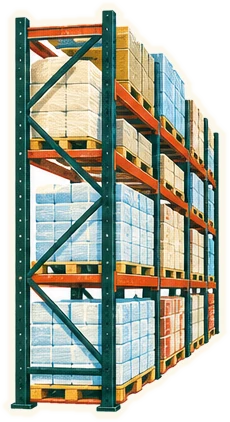
Storage Should Support Flow, Not Create Delay
Key considerations include product segregation, lot and batch control, FEFO, cold temperature, picking, pallet configuration, loading, hygiene and inventory accuracy. For perishable dairy, First Expired, First Out is often more relevant than simple first-in, first-out logic.
The objective is minimum unnecessary storage while maintaining reliable customer availability.

The Coordination Point Between Production and Market
A distribution center can consolidate products, orders, routes, customers and inventory: storage, cross-docking, order picking, mixed-case preparation, route assembly and returns handling.
The optimal network depends on factory locations + customer geography + order frequency + shelf life + transport economics
Move the Product Without Breaking the Chain
A dairy transport system should consider vehicle temperature, insulation, refrigeration, hygiene, loading sequence, route duration, door openings, product segregation, monitoring and maintenance.
A refrigerated truck is not automatically a controlled cold chain. Performance depends on how the complete journey is planned and executed.

Distance Is Only One Part of Delivery Cost
Route planning should consider customer density, time windows, vehicle capacity, product temperature, unloading time, traffic, returns and delivery frequency. Fresh dairy often requires high-frequency, time-sensitive distribution, which makes route density strategically important.
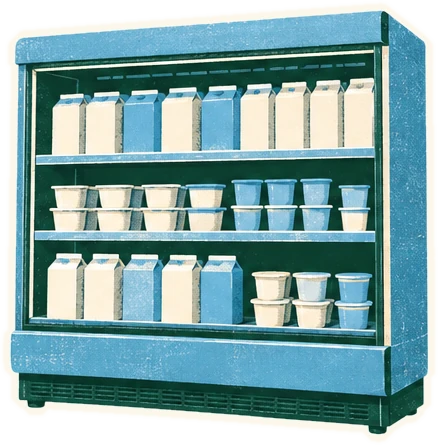
Not Every Product Belongs in Every Channel
The right channel mix depends on product and strategy. Pick a channel to see its character.
- Reach
- Margin
- Control
- Complexity
- Supermarkets
- Large reach, thin margin, listing fees and strict service levels.
- Traditional retail
- Many small stops, personal relationships, frequent deliveries.
- HoReCa
- Specialised formats, steady demand, professional account management.
- E-commerce
- Customer data and reach, expensive last mile and returns.
- Direct-to-consumer
- Premium margin and relationship; the producer carries every downstream task.
- Institutions
- Tender-based, predictable volume, strict specification.
- Export
- New markets, documentation, long cold chain.
Use Partners When They Improve Market Reach
A producer may distribute directly or work through wholesalers, regional distributors, importers, foodservice distributors and export agents. The trade-off involves control, reach, margin and complexity.
More direct distribution provides more control but also requires greater internal logistics and commercial capability.
- Direct
- Partners
- Control
- Reach
- Margin retained
- Complexity carried
- More direct distribution provides more control but also requires greater internal logistics and commercial capability.
- Wholesalers, regional distributors, importers, foodservice distributors and export agents add reach and share the complexity.
Where Product Availability Becomes Consumer Choice
Retail performance depends on listing, placement, availability, price, promotion, shelf condition, cold chain, merchandising and stock rotation.
A product that reaches the retailer but is frequently out of stock still has a downstream failure.
Dairy as an Ingredient and Service Product
Hotels, restaurants and cafés may require larger packs, different fat and protein specifications, frequent delivery, foodservice formats, predictable availability and professional account management. Commercial strategy should therefore distinguish consumer retail products from professional foodservice products.
- Retail
- Pack
- 200 g cup
- Specification
- Consumer taste and branding
- Delivery
- Weekly
- Account
- Chain buyer
- Foodservice
- 5 kg tub
- Consistent fat and protein for cooking
- Daily
- Dedicated account manager

Schools, Hospitals and Public Buyers
Institutional buyers may value nutrition, safety, specification, consistency, tender compliance, predictable supply and large-volume delivery. They can also create social-development opportunities through school milk or nutrition programs where such programs are established.
These markets should be treated as distinct channels rather than simply “large retail.”
- Public tender · school milk program
- Bid readiness
- Nutrition value
- Product safety
- Specification match
- Consistency
- Tender compliance
- Predictable supply
- Large-volume delivery
- MET
- of 7 criteria met
- Ready to bid.
Digital Access Creates Physical Delivery Requirements
E-commerce removes the traditional store from part of the purchasing journey, but it does not remove logistics. It increases the importance of inventory visibility, order accuracy and last-mile temperature control. It is a cross-domain system involving Channels + Commercial + Fulfillment + Logistics, and often Integrated.
- Browse
- The customer finds the product online.
- Channels
- Choose
- Price, offer and the basket.
- Commercial
- Pick & pack
- The order is prepared and packed cold.
- Fulfillment
- Chilled van
- The chilled last mile.
- Logistics
- Doorstep
- Delivered to the consumer.
- Consumer
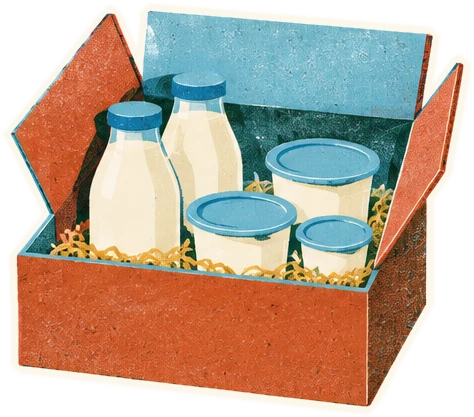
Closer Customer Relationships, More Operational Responsibility
Direct models can offer customer data, subscription, premium positioning, recurring orders and a farm or brand relationship. But they require consumer acquisition, order management, packaging, fulfillment, last-mile delivery and customer support.
Direct-to-consumer is not “removing the middleman for free.” It transfers more downstream responsibilities to the producer.
- Tick what a direct model gives you, then what it asks of you.
- You gain
- Customer data
- Subscriptions
- Premium positioning
- Recurring orders
- Farm or brand relationship
- You take on
- Consumer acquisition
- Order management
- Packaging
- Fulfillment
- Last-mile delivery
- Customer support
- balance

Why Should the Customer Choose This Product?
Products can compete on price, quality, taste, origin, tradition, freshness, convenience, nutrition, premium positioning, sustainability and trust.
Positioning should be consistent with product specification + packaging + channel + pricing + communication
- Price
- Quality
- Taste
- Origin
- Tradition
- Freshness
- Convenience
- Nutrition
- Premium
- Sustainability
- Trust
- Everyday value
- Heritage brand
- Premium farm

Price Is Part of the Commercial System
A downstream price architecture may include the producer selling price, distributor margin, wholesale price, retailer margin and consumer price. Promotions, rebates, listing fees and trade terms may alter the economics significantly.
A product can have healthy manufacturing margin and still become unprofitable after downstream commercial costs are included.
Availability Does Not Automatically Create Orders
Sales activity may involve account acquisition, territory management, key accounts, distributor management, forecasting, negotiation, promotions and order planning. The Commercial domain should measure not only revenue but gross margin, customer profitability, sales mix, returns and promotional effectiveness.
- By revenue
- By profit
- Supermarket chain
- Distributor north
- Hotel group
- Corner shops
- Online store
- School tender
- The biggest account by revenue looks safest.
- By profit the ranking changes.

Translate Product Value Into Customer Understanding
Marketing can include brand, packaging communication, campaigns, digital channels, social media, consumer education, sampling and trade marketing.
For dairy, responsible communication matters: claims about nutrition, health, origin, animal welfare and sustainability must be supportable and compliant.
- Claims must be supportable
- Brand
- A promise people recognise.
- Packaging
- Speaks at the shelf in two seconds.
- Campaigns
- Seasons, launches, moments.
- Digital
- Search, shops, retail media.
- Social
- Where recipes and reviews travel.
- Sampling
- Taste first, buy second.
Manage the Whole Dairy Shelf, Not Only One SKU
Large retailers and producers may use category analysis to understand consumer segments, pack sizes, price points, product substitution, promotion, shelf space and sales velocity. This creates a deeper commercial relationship than simply “selling cases.”
- Sales
- Margin
- Sales velocity
- Milk
- Yogurt
- Cheese
- Butter
- Cream
- Desserts
Produce and Position What the Market Will Need
Downstream demand information should feed back into production planning and ultimately raw-milk demand. Forecasting may consider historical sales, seasonality, promotions, weather, holidays, customer contracts, tourism and product launches.
Good downstream information reduces upstream and midstream waste.

The Commercial Promise Becomes an Operational Requirement
An order can contain the customer, product, quantity, price, requested date, delivery location and special requirements. Fulfillment converts that information into actions across inventory, picking, logistics, delivery and confirmation. This is why order management belongs to Fulfillment rather than Logistics alone.
- Customer
- Hotel Alpine
- Product
- Yogurt 5 kg
- Quantity
- 40 tubs
- Price
- €3.20
- Date
- Fri 07:00
- Location
- Rear dock
- Special needs
- Temp log
- Inventory
- Picking
- Logistics
- Delivery
- Confirmation
Who Gets Which Product?
When inventory is limited, businesses may need rules for customer priority, shelf life, region, promotion, profitability and contractual obligations.
Allocation decisions directly affect customer service and waste.
- Key account
- Hotel group
- Corner shops
- Online
- Priority
- Shelf life
- Profitability
- Contract

Correct Product, Correct Quantity, Correct Batch
Picking errors can create incorrect deliveries, returns, credits, route inefficiency and damaged customer trust. Digital scanning and warehouse systems can improve SKU accuracy + batch traceability + inventory control.
- Whole milk 1L
- B-2210
- Yogurt 400g
- B-2207
- Cheese 200g
- B-2198
- B-2205
- Butter 250g
- B-2201

Measure Whether the Promise Was Kept
Useful metrics may include OTIF (On Time In Full), order accuracy, delivery lead time, temperature compliance, damage rate, returns and customer complaints. Downstream performance should measure the complete customer outcome.

The Most Expensive Kilometres Can Be the Final Ones
Last-mile dairy can be challenging because orders may be small, customers are dispersed, delivery windows are narrow and refrigeration remains necessary. This is especially important for e-commerce, direct-to-consumer, small retailers and foodservice.
- lastmile

The Consumer Is the Ultimate Purpose of the Chain
The dairy value chain creates value only if the final product is purchased, used and appreciated by the consumer or customer. Consumption closes the commercial loop but opens an information loop: preferred taste, format, pack size, price sensitivity, convenience, perceived quality and waste patterns. This information should travel back through the dairy system.
- Preferred taste
- Recipe and flavour adjustments.
- Format
- Cup, bottle, pouch, bulk.
- Pack size
- Single serve to family pack.
- Price sensitivity
- Where the price ceiling sits.
- Convenience
- On-the-go, ready, resealable.
- Perceived quality
- Complaints and praise.
- Waste patterns
- What is thrown away, and why.
Quality Continues Beyond the Factory Gate
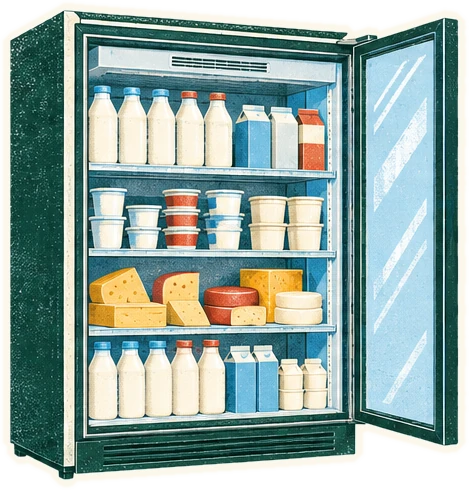
Consumer experience depends on taste, freshness, package function, appearance, convenience, confidence and product information. A perfect factory batch can still deliver poor consumer experience if transport breaks the cold chain, the retailer mishandles the product, packaging leaks or shelf life is insufficient.
Downstream protects the value created in Midstream.
- Cold chain broken in transport
- Retailer mishandles the product
- Packaging leaks
- Shelf life too short

The Value Chain Sometimes Moves Backward
Returns may result from a wrong delivery, damaged packaging, short shelf life, temperature failure, a quality issue, overstock, expired product or a recall. They should be identified, segregated, recorded, investigated and resolved. This belongs primarily to Fulfillment, with Logistics handling the reverse movement.
- Wrong delivery
- Damaged packaging
- Short shelf life
- Temperature failure
- Quality issue
- Overstock
- Expired
- Recall
- Return to stock
- Reallocate or discount
- Investigate
- Identify
- Segregate
- Record
- Resolve
Moving Products and Materials Back Through the Network
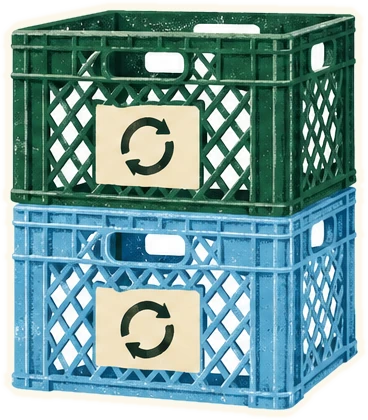
Reverse logistics can include returned product, reusable pallets, crates, insulated containers, recalled goods, packaging and equipment. The objective may be reuse, recovery, controlled disposal or recycling, depending on the material.
- Pallets
- Crates
- Insulated boxes
- Recalled goods
- Packaging
- Equipment
- Objective: reuse → recovery → controlled disposal → recycling, depending on the material.

Traceability Must Work in Both Directions
A recall system should identify which products are affected, where they were delivered, which customers received them and which batch or input caused the issue. This connects Midstream batch traceability with Downstream customer and distribution traceability: farm → factory → pack → customer and back again.
- Farm A
- Farm B
- Farm C
- Batch 41
- Batch 42
- Batch 43
- Chain 1
- Chain 2
- Hotel
- School
- Shop

Prevent Expiry Before Managing Waste
The preferred hierarchy: better forecasting, better rotation, reallocation, discounting where safe and appropriate, donation where legally and safely possible, recovery, controlled disposal.
Expired dairy is often evidence of a forecasting, inventory, pricing or distribution problem earlier in the chain.
- Forecast better
- Make and send the right amount.
- Rotate stock
- FEFO: the oldest dated first.
- Reallocate
- Move stock to where it will sell.
- Discount safely
- Where safe and appropriate.
- Donate
- Where legally and safely possible.
- Recover
- Back into useful material.
- Controlled disposal
- The last resort.
Downstream Waste Represents Upstream Resources Already Spent
A discarded yogurt or cheese has already consumed feed, water, animal productivity, farm energy, processing energy, packaging, refrigeration and transport. Key actions include forecasting, FEFO, shelf-life management, pack sizing, markdowns, redistribution, donation and consumer education.
Preventing food waste can preserve more value than treating waste after it occurs.
- Feed
- Water
- Animal productivity
- Farm energy
- Processing energy
- Packaging
- Refrigeration
- Transport

The Product Is Consumed; the Package Remains
Dairy packaging may include plastic bottles, cups, films, cartons, aluminum lids, glass, cardboard and transport packaging. The dairy company may not operate the recycling plant, but product and packaging decisions influence whether materials can be collected, sorted, reused or recycled after consumption. This is where post-consumption responsibility begins.
- Plastic bottle
- Cup
- Film
- Carton
- Aluminium lid
- Glass
- Cardboard
- Transport wrap
- Collected
- Sorted
- Recycled
Design for the System That Exists, or Help Improve It
Responsibilities may include choosing recyclable materials where technically suitable, reducing unnecessary material, giving clear disposal instructions, working with waste collectors, joining recovery programs, supporting collection infrastructure and using recycled content where safe and appropriate.
Recycling claims should reflect actual local collection and processing capability, not theoretical recyclability alone.
- cascade
- Prevent
- Make and ship only what will be used.
- Reuse
- Keep it in circulation where suitable.
- Recycle
- Where the local system can.
- Recover
- Energy or nutrients where appropriate.
- Dispose
- Responsibly, last.
Some Packaging and Transport Assets Can Circulate
Reusable elements include pallets, crates, insulated boxes, distribution containers and some bottle systems where appropriate. Reuse requires tracking, collection, cleaning, inspection and return logistics: a Fulfillment + Logistics + Facilities issue rather than a separate Environment domain.
- reuse
Commercial Responsibility Can Continue After Sale
In jurisdictions where producer-responsibility schemes apply, producers or importers may have financial, reporting or operational responsibilities related to packaging waste or product recovery. The details vary by country and regulation, so jurisdiction-specific compliance belongs in current regulatory content.
This illustrates why post-consumption issues belong in Downstream strategy even when actual recycling occurs outside the dairy sector.
- Producer
- Places packaged product on the market.
- fee + reporting
- Scheme
- Collects fees and reports.
- Collection
- Households and businesses.
- Sorting
- Separates materials.
- Recycler
- Turns sorted material into raw material.
- Illustrative flow. Schemes, fees and duties differ by country.
Reduce the Footprint of Moving Cold Products
Key areas include route efficiency, vehicle utilization, refrigeration efficiency, low-emission fleets, warehouse energy, refrigerant management, packaging efficiency and food-waste reduction.
Distribution sustainability should be measured per useful delivery or unit of product, not simply by counting vehicles or warehouses.
- Per vehicle
- Per useful delivery
- Few large trucks, full
- Many half-empty vans
- Planned routes, low-emission fleet
- Counting vehicles hides how much each one carries.
- Measured per useful delivery, the planned fleet comes out best.
Unsold Does Not Always Mean Unusable
Where food remains safe and legally eligible, structured redistribution may reduce waste and support communities. A proper system requires food-safety rules, remaining shelf life, temperature control, liability clarity, recipient coordination and traceability.
The goal should never be to use donation as a substitute for poor inventory management.
- Before anything is donated
- Every box must be ticked
- Food is safe
- Legally eligible
- Enough shelf life left
- Temperature kept
- Recipient ready
- Traceable
- Donate
- Structured redistribution reduces waste and supports communities.
- gate
Sell Dairy Without Overstating the Product
Marketing should avoid unsupported claims concerning health, sustainability, animal welfare, origin, naturalness and carbon performance.
Commercial strength and truthful communication should reinforce each other.
This connects directly to GEO Dairy’s ESG principles.
- “Boosts immunity”
- Needs: clinical or regulatory evidence
- “Carbon neutral”
- Needs: audited carbon accounting
- “100% natural”
- Needs: specification and ingredient records
- “From local farms”
- Needs: origin traceability
- “High in protein”
- Needs: laboratory analysis and compliant threshold
Better Information Can Improve Use and Reduce Waste
Useful consumer information may include storage instructions, use-by and best-before interpretation where applicable, nutritional information, recycling instructions, pack disposal and product usage.
This can improve consumer trust + food safety + waste reduction
- Natural Yogurt 400 g
- Storage instructions
- Keep at 2–6 °C. Do not freeze.
- Use-by or best-before
- Use-by: date and batch printed on the lid.
- Nutrition information
- Per 100 g, in plain language.
- Disposal and recycling
- Rinse the cup, remove the lid, sort by material.
- Usage ideas
- Breakfast, sauces, baking.
Cross-Border Sales Add Another Layer of Complexity
Export distribution can require an importer or distributor, documentation, customs, sanitary and veterinary certification, labeling compliance, cold chain, port and border logistics, a local warehouse and market registration. Downstream export strategy connects closely with Midstream product compliance.
- Importer
- Documents
- Customs
- Veterinary certificate
- Labeling
- Cold chain
- Port or border
- Local warehouse
- Registration
One Product, Multiple Customer Routes
A dairy brand may sell through supermarkets, traditional retail, HoReCa, e-commerce, direct-to-consumer and institutions at once. This can improve reach but increases complexity. An integrated system must coordinate pricing + inventory + orders + logistics + customer data across channels, which often belongs to DX Integrated.
- Supermarkets
- HoReCa
- E-commerce
- Direct
- Institutions
- Retail shops
- Price ↔ stock
- Orders ↔ data
- Coordinate the channels
Digital Systems Connect Demand With Physical Product
Relevant systems include CRM, ERP, WMS, TMS, OMS, e-commerce, route optimization, temperature monitoring, proof of delivery, barcode, QR and RFID systems, and analytics.
The digital objective: one visible flow from demand to delivery and back to market intelligence.
- CRM
- Customers and accounts.
- E-commerce
- The digital shop front.
- ERP
- Money, stock and master data.
- OMS
- Orders from capture to completion.
- WMS
- Warehouse stock and picking.
- TMS
- Transport planning and tracking.
- Route optimizer
- Best sequence for each round.
- Temp monitoring
- Live cold-chain visibility.
- Proof of delivery
- Signed and timestamped.
- Barcode · QR · RFID
- Identify every unit and batch.
- Analytics
- Turn it all into decisions.
- Demand
- Delivery
- Market intelligence
Downstream Produces the Market Signals the Rest of Dairy Needs
Useful data include sales by SKU and region, price, channel, promotion, returns, waste, customer profitability, forecast accuracy and service levels. These signals should feed Downstream → Midstream production planning → Upstream milk demand: the reverse information chain.
- Capital
- West
- East
- South
- North
- Milk 1L
- Yogurt
- Cheese
- Butter
- Cream
- Dessert
- Sales
- Price
- Returns
- Waste

Use Data to Improve Market Decisions
Potential applications include demand forecasting, pricing analysis, promotion optimization, inventory allocation, route planning, churn prediction, customer segmentation and waste prediction.
AI should improve a defined decision, not become a standalone objective.
- Demand forecasting
- Decision: how much to make and ship.
- Pricing analysis
- Decision: which price protects margin.
- Promotion optimization
- Decision: which offers pay back.
- Inventory allocation
- Decision: who gets scarce stock.
- Route planning
- Decision: the best sequence per round.
- Churn prediction
- Decision: which accounts drift away.
- Customer segmentation
- Decision: who buys what and why.
- Waste prediction
- Decision: what will expire unsold.
Commercial and Physical Execution Require Different Skills
Typical roles run from sales and category management to warehouse, dispatch and driving. This is one reason Commercial, Logistics and Fulfillment should remain separate domains.
- Sales manager
- Negotiation, accounts.
- Category manager
- Shelf analytics.
- Marketing lead
- Brand and campaigns.
- Order desk
- Capture and customer service.
- Planner
- Routes and allocation.
- Warehouse operator
- Picking and loading.
- Dispatcher
- Rounds and exceptions.
- Driver
- Safe, cold, on time.
- Commercial
- Physical
The Consumer Price Is Not the Producer’s Revenue
The final retail price may need to cover manufacturing, packaging, warehouse, transport, sales, trade margins, promotions, returns, retail margin and taxes.
A product can appear profitable at factory gate but become unattractive after the full cost-to-serve is included.
Downstream economics should measure net sales, gross margin, cost-to-serve, logistics cost, channel margin, returns and promotional cost.
- Manufacturing
- Packaging
- Warehouse
- Transport
- Sales
- Trade margin
- Promotions
- Returns
- Retail margin
- Taxes

Not All Revenue Has the Same Value
Two customers buying the same annual volume may generate different profit because of delivery frequency, distance, order size, discounts, returns, payment terms and promotional support. Commercial decisions should consider customer profitability, not sales revenue alone.
- daily, far, small orders, discounts
- weekly, close, large orders, few returns
Every Route to Market Has a Cost Structure
Distributor model: lower direct infrastructure, lower control and margin. Direct retail delivery: more control, higher logistical complexity. E-commerce: direct customer data, expensive last mile. Specialty retail: higher potential margin, limited scale. The correct channel mix depends on product and market.
- Product
- Distribution
- Trade terms
- Last mile
- Marketing
- Margin
- Distributor
- Direct retail delivery
- E-commerce
- Specialty retail
Preserve Value All the Way to Consumption
Downstream sustainability should consider refrigeration, transport, warehousing, product loss, food waste, packaging, returns, reverse logistics, consumer information and the recycling interface.
The environmental value of efficient farming and processing is lost if the finished product is wasted before consumption.
- Farm
- Factory
- Cold chain
- Retail
- Home
- FEFO and forecasting
- Controlled cold chain
- Right pack sizes
- Consumer information
Close the Loop Where Practical
Product → consumer → package or residual product → collection → reuse, recycling or recovery → new resource. Not every package or waste stream can economically or safely be recycled. The correct principle:
prevent first, reuse where suitable, recycle where viable, recover where appropriate, dispose responsibly as the last option.
- circle
- Product
- Consumer
- Package or residue
- Collection
- Reuse · recycle · recover
- New resource
- Prevent first. Reuse where suitable. Recycle where viable. Recover where appropriate. Dispose responsibly last.
Different Market Problems Require Different Professional Actions
Within each Downstream domain, GEO Dairy may provide or coordinate five kinds of professional action. Downstream → Logistics → Engineering is different from Downstream → Logistics → Operations. Turn the dial.
What the Market System Needs to Obtain
The same domains can require infrastructure, equipment, inputs, finance and workforce. Pick a domain to grow its branches.
Who Participates After the Factory?
The Downstream ecosystem is much broader than “transport companies”: producers, distributors, retailers, foodservice, institutions, e-commerce platforms, logistics and cold-storage operators, marketing agencies, waste and recycling partners, community organizations and consumers.
- Make and sell
- Producers
- Marketing agencies
- E-commerce platforms
- Move and store
- Distributors
- Logistics operators
- Cold-storage operators
- Serve and buy
- Retailers
- Foodservice
- Institutions
- Consumers
- After use
- Waste partners
- Recycling partners
- Community organizations
The Market Determines What the Factory Should Make
Downstream sends signals such as product demand, pack size, volume, shelf life, price point, promotion and quality expectations. These flow into Midstream production planning and eventually into Upstream milk requirements.
Downstream demand should shape Midstream production, not merely absorb whatever the factory happens to make.
- pull
- Product demand
- Pack size
- Volume
- Shelf life
- Price point
- Promotion
The Value Chain Ends in Use, but Learning Begins There
Consumer feedback can influence product reformulation, packaging, sizes, pricing, convenience, sustainability and new products. Modern dairy businesses should treat consumer data as an input to the entire value chain.
- “A bit too sweet.”
- Reformulation
- Reduce sugar by 15%.
- “I can’t open the lid.”
- Packaging
- Easy-peel foil lid.
- “Too much for one person.”
- Pack size
- A 125 g single serve.
- “Expensive for every day.”
- Pricing
- A value multipack.
- “Nothing I can take to work.”
- Convenience
- A resealable drinkable pouch.
- “Is the pack recyclable?”
- Sustainability
- Mono-material cup with clear bin labeling.
- “Do you make it plain, no flavor?”
- New product
- Unflavored high-protein line.
Downstream Connects Dairy to the Circular Economy
The dairy business may interface with municipal collection, packaging-recovery organizations, recyclers, composting, anaerobic digestion, waste-to-energy and specialized food-waste processors. These are not necessarily dairy businesses, but they become part of dairy’s extended responsibility once finished products and packaging enter society.
- An illustrated circular-economy site with a waste collection truck, a sorting plant, a compost field, a biogas plant, a pellet warehouse and a crate washing station, linked by roads that loop back to a dairy plant.
- Municipal collection
- Household and commercial pickups.
- Packaging recovery
- Producer-funded organizations.
- Recyclers
- Turn sorted material into raw material.
- Composting
- Organic residues back to soil.
- Anaerobic digestion
- Biogas from food residues.
- Waste-to-energy
- For what cannot be recycled.
- Food-waste processors
- Specialized treatment of food residues.
- Dairy industry
- Circular-economy industries
Connecting Distributed Production to Organized Demand
Dairy Grid requires a strong downstream system because distributed production creates value only if finished dairy products can reach customers predictably and competitively. Higher-level Downstream systems can serve the output of many independently owned Grid businesses.
Distributed production can serve coordinated markets.
Demand Should Travel Back Through the Grid
A digital Grid could eventually connect customer orders, the processing plan, the milk requirement and farm production planning, and provide feedback on product demand, prices, quality, returns and waste.
It becomes an information network connecting consumer demand back toward biological production.
- Customer orders
- Demand by SKU, region and date.
- Processing plan
- What the factory makes and when.
- Milk requirement
- Litres and quality needed.
- Farm planning
- Herd, feed and calving plans.
- Product demand
- Prices
- Quality
- Returns
- Waste
Network Scale Can Support Recovery Systems
A national network may eventually coordinate reusable crates, pallet return, package-collection partnerships, expired-product recovery, food donation, waste-data reporting and recycling relationships. Individual small businesses may struggle to establish these systems alone, while a coordinated network can create enough volume to make them practical.
- unlock
- Reusable crates
- Pallet return
- Package-collection partnerships
- Expired-product recovery
- Food donation
- Waste-data reporting
- Recycling relationships
Market Systems Also Shape Society
A capable downstream dairy system can contribute to food availability, regional distribution, rural producer market access, nutrition programs, local retail, job creation, consumer information and waste reduction. This is where the commercial system meets the broader national dairy ecosystem.
- Food availability
- Regional distribution
- Rural producer market access
- Nutrition programs
- Local retail
- Job creation
- Consumer information
- Waste reduction
Start With the Technical Need, or Let Navigator Guide You
Visitors who already understand their need can select a domain, then choose Service or Supply. A visitor who describes a problem may need analysis across several domains, rather than simply “better transport.” Navigator helps diagnose the combination.
Explore the Downstream Domains
Six major cards. Open one to choose what you need: a professional service, or something to supply.
Downstream Is Not Limited to One Business Model
Three families of customer: business-to-business, business-to-consumer and export.
- Business to business
- Wholesalers
- Distributors
- Supermarkets
- Traditional retail
- HoReCa
- Institutions
- Industrial buyers
- Business to consumer
- E-commerce
- Direct-to-consumer
- Subscriptions
- Farm shops
- Marketplace sellers
- Export
- Importers
- Export distributors
- Foreign retailers
- Cross-border e-commerce
What a Downstream Dashboard Could Show
The exact KPIs vary by business, but the concept is important: commercial, logistics, fulfillment, inventory and sustainability measures read together.
- All
- Commercial
- Fulfillment
- Logistics
- Inventory
- Sustainability
- Net sales
- Gross margin
- Customer profitability
- OTIF
- Order accuracy
- Returns
- Delivery lead time
- Temperature compliance
- Cost to serve
- Stock cover
- days
- Expiry losses
- Packaging recovered
Explore the Dairy Industry

The Dairy Value Chain Is Not Complete Until the Product Creates Value for the Consumer
A finished dairy product has no economic purpose simply because it has left the factory. It must reach the right customer, through the right channel, at the right time, in the right condition and at an economically sustainable cost.
And responsible Downstream management does not stop completely at consumption. Returns, food waste, packaging and post-consumer materials create additional responsibilities and opportunities to recover value, reduce environmental impact and strengthen the relationship between the dairy industry and society.
The Market Side of Dairy Also Creates Social Outcomes
Potential areas include food access, responsible nutrition communication, school and institutional programs, food donation, fair commercial practices, safe working conditions, responsible consumer marketing, support for local retailers and rural-to-urban market connections.
Social responsibility should be integrated with the actual business model rather than treated as a separate campaign disconnected from operations.