


A professional market connecting real dairy producers with real customers.
Dairy Market is GEO Dairy’s curated digital marketplace for the dairy industry. It is designed to connect verified farmers, processors, producers, distributors, wholesalers, importers, exporters and other market participants with businesses, retailers, HoReCa operators, institutions, factories and consumers looking for dairy products.
Starting in Georgia and designed for international expansion, Dairy Market aims to make dairy commerce more structured, transparent, competitive and accessible.
Production capability alone does not create a successful dairy industry. Farmers need reliable buyers. Processors need raw materials and customers. Distributors need products. Retailers need dependable suppliers. HoReCa businesses need consistent specifications. Importers and exporters need credible counterparties.

Yet dairy markets can remain fragmented.
Dairy Market exists to reduce that information gap. The market should make capable sellers easier to find and serious demand easier to reach.
Dairy Market is a structured digital environment where approved market participants can present supply, communicate demand, discover counterparties and develop commercial transactions.
Dairy Market is not:
an uncontrolled classifieds website
a social-media sales group
a platform where anonymous sellers can advertise unverified food
only an online retail shop
only an export portal
only a wholesale market
only a Dairy Grid sales channel
GEO Dairy’s private sales catalogue
This distinction is extremely important.

GEO Dairy may itself buy, sell, distribute or commercially represent finished dairy products.
Provides the wider digital market environment in which independent producers, buyers, distributors, importers, exporters and other participants can connect.
Because GEO Dairy may itself participate commercially in some markets, Dairy Market applies transparent marketplace rules so independent sellers are not disadvantaged simply because the platform operator also has commercial activities.
Dairy Market competes on trust, not privileged access.




Potential seller profiles include:
 Dairy farmers
 Milk producer groups
 Dairy processors
 Cheese makers
 Artisanal producersIndustrial manufacturers
 Wholesalers
 Distributors
 Importers
 Exporters
 Authorized commercial representatives
 Dairy Grid production businesses
Potential buyers include:
Dairy FactoriesBuying raw milk or dairy ingredients.
DistributorsBuilding product portfolios.
WholesalersBuying larger commercial quantities.
 Retailers
Supermarkets, grocery chains and specialty stores.
 HoReCa
Hotels, restaurants and cafés.
 Food Manufacturers
Using dairy as an ingredient.
 Government & Public Institutions
Where procurement rules allow platform participation.
 Schools, Hospitals & Institutions
Buying compliant food products.
ExportersSourcing for external markets.
ImportersSeeking products from foreign producers.
 Businesses
Corporate/institutional consumption.
 Consumers
Where B2C functionality is enabled.
One platform, different market modes.
Buyer discovers available products.
The basic market loop.

The value of Dairy Market depends more on who participates than on how many listings exist.

Possible seller statuses:
The platform should be careful never to imply GEO Dairy guarantees the seller unless it actually assumes that contractual responsibility.
A listing will not consist only of photo + title + price. A structured dairy product record can make professional comparison possible.
Professional buyers need more than consumer-facing product descriptions.
Milk prices may be: publicly displayed · indicative · formula-based · request-for-quote · contract-only. The platform should support different commercial practices.
Professional filters might include:
Filters can also cover: Product category · Producer · Country · Region · Raw / finished product · B2B / B2C · Pack size · Minimum order · Monthly capacity · Shelf life · Storage temperature · Private label · Export readiness · Certification · Delivery area.
Sulguni 1 kgImereti · 300 / monthExport ready · Private label Bulk mozzarella 2 kgKakheti · 1200 / monthExport readyNatural yogurt 5 kg tubAdjara · 800 / monthPrivate labelFoodservice butter 5 kgImereti · 400 / monthExport ready · Private label
 Long-life milk 1 lKakheti · 5000 / monthExport ready
 Kefir 0.9 lAdjara · 2000 / monthMatured cheese wheelKakheti · 150 / monthExport ready · Private label
 Cooking cream 1 lImereti · 900 / monthPrivate label
8 of 8 sample listings Illustrative listings.
This is one reason structured listings are essential.
This is one of the most important features. Instead of requiring suppliers to constantly advertise, buyers can publish structured requirements:
“Need 2 tonnes/week of foodservice mozzarella delivered to Tbilisi.”
“Seeking Georgian cheese portfolio for export distribution.”


A market becomes more useful when both supply and demand are visible.
An RFQ can allow selected qualified sellers to respond with price, specification, volume, delivery, lead time, payment terms, validity and supporting documents. The buyer can then compare offers using the same structure.
Illustrative offers. Click a row to compare.
Potential users: hotel groups, supermarket chains, distributors, factories, institutions and public bodies where legally permitted.
Potential buyers can include:
Dairy Market can support supplier discovery, catalogue visibility, requirement publication and market research.
Where government procurement legislation requires transactions through an official procurement system, Dairy Market will connect to or inform that process rather than claim to replace it.
It can still help businesses discover and prepare for opportunities.
Different buyers use the market differently, so each gets its own professional way of working.
A hotel chef should not need to search through consumer listings. HoReCa buyers should be able to filter:
The interface will adapt to the buyer type.
This creates a professional sourcing workspace rather than merely a public product page.
Producers can indicate “Seeking Distributor”. This can dramatically improve commercial matchmaking.
This helps turn the platform into a network of international commercial relationships rather than only an online shop.
Dairy Market can progressively connect, where operationally relevant:
For Dairy Grid products, deeper traceability may eventually connect:
This should be enabled without exposing commercially sensitive data unnecessarily.
A listing may need evidence appropriate to food-business status, product labeling, veterinary requirements, import / export requirements, certification, quality documentation.
 Make Professional Procurement Easier
Verified businesses could maintain controlled documentation. Buyers can request access rather than repeatedly asking sellers to email the same documents. Permissions will protect confidential information.
Marketplace verification cannot replace government food-safety control, laboratory testing or regulatory authorization. Dairy Market will show the status of documents rather than falsely claiming the platform itself certifies product safety.
Over time, anonymized data can help participants understand price ranges, demand trends, regional differences, seasonality, product growth and volume. A public market dashboard could report aggregated information without exposing confidential contracts.
Aggregated platform data can eventually support farmers, processors, investors, GEO Dairy and potentially public industry planning. Individual company data should remain appropriately protected.
Illustrative chart.This could become highly valuable for Georgia’s fragmented dairy market.
Ratings will be based primarily on verified interactions, not anonymous internet comments. This protects both buyers and sellers.
Trust Can AccumulateExact commercial volumes and values can remain private unless participants choose otherwise.
Illustrative profile.
The platform will distinguish between public marketplace information and transaction-confidential information. Role-based access will control sensitive data.
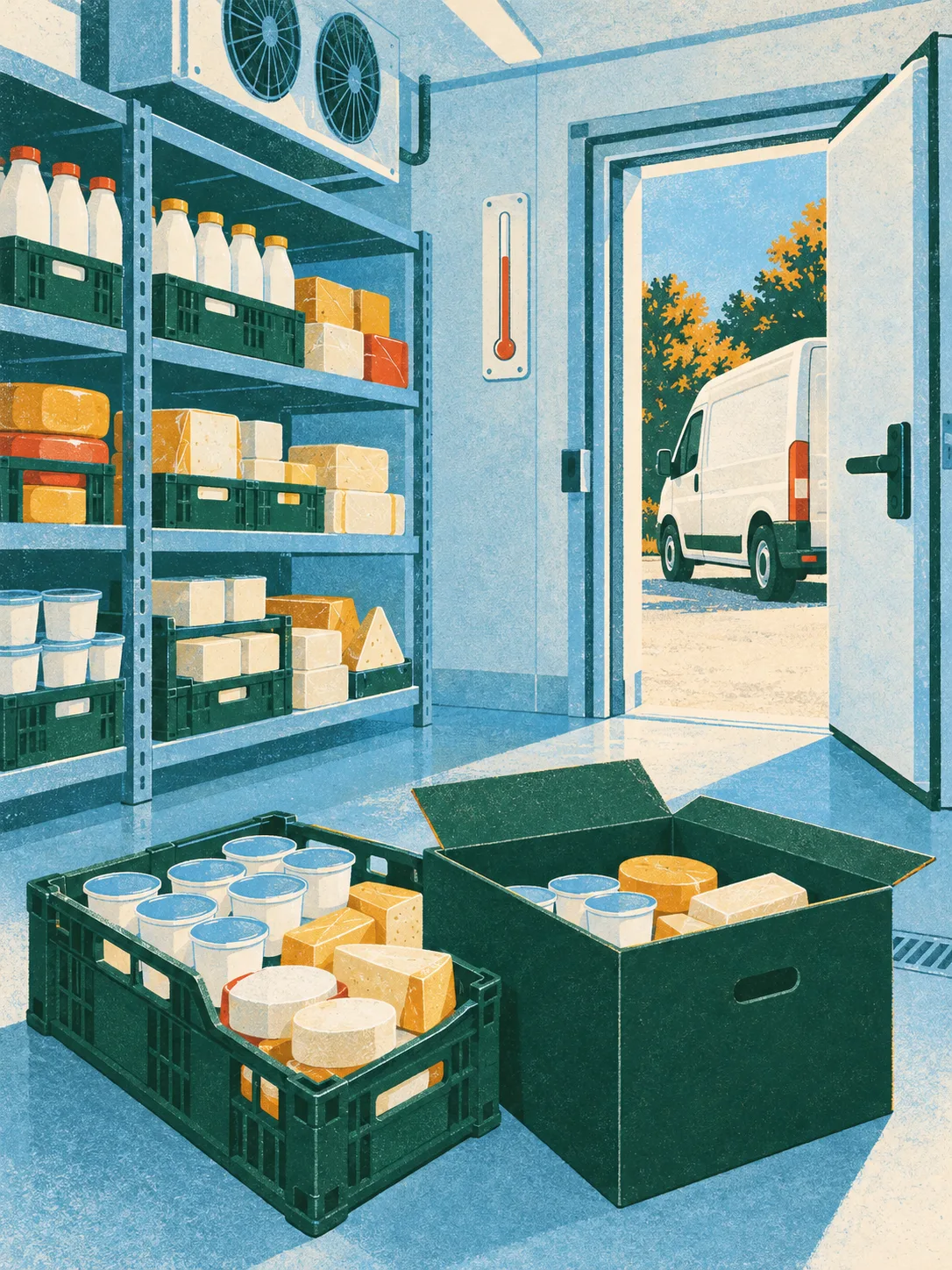
Dairy Market can connect transactions with cold storage, transport, refrigerated delivery, export freight and distribution. Logistics can eventually be matched through GEO Dairy’s wider ecosystem.

depending on the commercial arrangement.
Protect the Product Through DeliveryFor temperature-sensitive transactions, the platform can eventually capture:
Dairy Market is strategically important to Dairy Grid.

Dairy Grid organizes production. Dairy Market organizes access to demand.
Dairy Market works beside the other GEO Dairy programs without replacing any of them.
 Teach Producers How to Become Market-Ready
Market data can reveal capability gaps. Dairy Academy can offer learning in:
Market intelligence therefore becomes an input to professional education.
Recognition Can Improve Discovery, But Not Replace VerificationDairy Award winners may have award status displayed on their Dairy Market profile.
But winning an award should not exempt a seller from the marketplace’s normal verification or commercial-performance requirements. Award recognition and Market verification should remain separate.
Even before full B2C e-commerce, consumers may benefit from:
This can build visibility for Georgian dairy producers without making consumer retail the core business model.
Potential browsing modesRegional discovery can support tourism, local identity, specialty products and smaller producers. This should rely on verified product origin rather than marketing claims alone.
etc.
The professional data should come before marketing storytelling.
Producer page might showBuyer profile, where appropriateSensitive purchasing information remains private.
 Reduce Waste Without Damaging Food Safety
A controlled B2B function could eventually help redistribute surplus inventory, short-dated products and excess production where products remain fully legal and safe.
The Market should never facilitate sale of expired or non-compliant food.
 Food Donation Interface
Where appropriate, participants may connect eligible surplus to charitable organizations, social institutions and food-support programs.
Food safety, cold chain, traceability and legal requirements still apply. This provides a social-responsibility layer without converting Dairy Market into a charity platform.
 Packaging & Sustainability Information
Listings may eventually include structured information on:
Any sustainability claim should be evidence-based. This connects Dairy Market to GEO Dairy’s broader ESG principles.
A smaller producer may not have a national sales team or large marketing budget. Dairy Market can make that producer discoverable to professional buyers if the product, business and supply capability meet the required standards.

This aligns strongly with GEO Dairy’s philosophy: small businesses should be able to access larger-system capability without giving up their independence.
Buyers should be able to compare these factors. This helps prevent Dairy Market from becoming a race to the lowest price regardless of quality.
Choose what matters. Illustrative ranking.
Transparency can mean:
It does not require disclosure of every private commercial term. Transparency means knowing what you are comparing and who you are dealing with.
Potential applications include:

AI recommendations will remain explainable where they materially influence supplier visibility.
Grid builds production. Academy builds capability. Market connects commerce. Award recognizes excellence.
01Dairy GridOrganize dairy production.
Open02Dairy AcademyBuild professional capability.
Open 03Dairy Market
Connect supply with demand.
You are here04Dairy AwardRecognize excellence.
In preparationFarmers and producers should not be limited to the buyers they already happen to know. Buyers should not be limited to the suppliers they already happen to know.
Dairy Market is designed to make legitimate dairy supply and legitimate dairy demand easier to discover, compare and connect, through a professional environment built around real businesses, structured product information, transparent market rules and measurable commercial performance.
Beginning in Georgia and designed for international growth, Dairy Market can become the commercial meeting place of the wider dairy ecosystem.
