

Why Georgia
A strategic location, an established agricultural base and a dairy industry with significant room to modernize, integrate and grow.
Georgia offers a distinctive platform for dairy development. The country combines local milk production and dairy consumption, diverse agricultural regions, access to neighboring and international markets, an open trade orientation and a growing need for modern farming, processing, logistics and market systems.
An Opportunity Created by Both Strengths and Gaps
Georgia combines an established dairy culture and agricultural base with substantial room for modernization, consolidation of capabilities, professionalization and value-chain development.
Georgia’s dairy opportunity does not come from one single advantage. It comes from the combination of an existing dairy sector, fragmented production, developing commercial farms, domestic demand, processing capacity, regional diversity, international trade connections and significant gaps in productivity, technology, genetics, feed systems, quality, logistics and professional services.
These gaps represent challenges, but they also create clear areas where investment, technology and better organization can generate value.
Existing dairy sectorProductivityDeveloping commercial farmsTechnologyDomestic demandGeneticsProcessing capacityFeed systemsRegional diversityQualityInternational trade connectionsLogisticsFragmented productionProfessional services
Georgia is attractive not because the dairy system is already complete, but because many of the building blocks exist while substantial value remains to be created between them.
Between Europe, the Caucasus, Central Asia and the Black Sea
Georgia sits between the Black Sea and the South Caucasus, connecting routes toward Europe, Türkiye, the Caspian region, Central Asia and wider Asian markets.
For dairy businesses, this location can support several types of commercial activity:
Georgia is also an active part of the Middle Corridor, the multimodal route linking Europe and Asia through the South Caucasus and Caspian region; Georgia’s Ministry of Economy continues to describe transport-capacity expansion as a strategic priority. Economy Georgia
A Platform Connected to Large Markets
Georgia has developed an unusually broad network of free-trade relationships for a country of its size. These arrangements can make Georgia relevant not only as a domestic market, but also as a platform for production and trade.
Free-trade access does not automatically mean that every dairy product can enter every market without further conditions. Dairy exports remain subject to rules of origin, veterinary/SPS requirements, establishment approvals, certification, product standards and the specific conditions of the destination market.
Economy GeorgiaCurrent arrangements include trade frameworks with
DCFTAEuropean UnionFTAEFTA countriesFTAUnited KingdomFTATürkiyeFTAChinaFTAHong Kong, ChinaFTAUnited Arab EmiratesFTACIS and regional markets
For dairy, entry also requires
- Rules of origin
- Veterinary / SPS requirements
- Establishment approvals
- Certification
- Product standards
- Destination-market conditions

Dairy Is Already Part of Georgia’s Food Economy
Georgia is not starting from zero. Milk, cheese, fermented dairy products and other dairy foods already form an established part of local production and consumption.
The opportunity is therefore to improve the efficiency, consistency, safety, scale and commercial organization of an existing sector rather than create consumer demand from nothing.
Existing Production, Uneven Productivity
One of Georgia’s most important dairy characteristics is the coexistence of traditional household production, smaller farms and a growing number of more commercial operations. This creates a wide productivity gap, and therefore a substantial modernization opportunity.
Traditional household production
Smaller farms
More commercial operations
Small Businesses Do Not Need to Remain Isolated
Fragmented production is often described only as a weakness. GEO Dairy sees a second possibility: small and medium-sized businesses can remain independently owned while selected capabilities are organized collectively.
Veterinary services, genetics, feed preparation, calf rearing, milk collection, processing, digital systems, finance and logistics do not necessarily need to be duplicated at every farm. This makes Georgia especially relevant for distributed models such as Dairy Grid.
The opportunity is not simply to replace many small farms with a few large farms. It is also to make smaller businesses capable of participating in a professional network.
Different Regions, Different Dairy Opportunities
Georgia should not be presented as one homogeneous production zone.
Georgia’s geography creates very different agricultural environments across relatively short distances. Elevation, rainfall, temperature, soil, crop potential, access to irrigation, proximity to cities and transport infrastructure can differ substantially by region.
This diversity allows different dairy business models to be considered rather than applying one national farm template everywhere.
Explore the Regions of Georgia · in preparation
- Elevation
- Rainfall
- Temperature
- Soil
- Crop potential
- Access to irrigation
- Proximity to cities
- Transport infrastructure
- Intensive dairy farmingOne farm template
- Feed crop productionOne farm template
- Silage and grain businessesOne farm template
- Calf / heifer rearingOne farm template
- Milk aggregationOne farm template
- Cheese productionOne farm template
- Regional processingOne farm template
- Cold storageOne farm template
- DistributionOne farm template
Dairy Development Begins With Feed
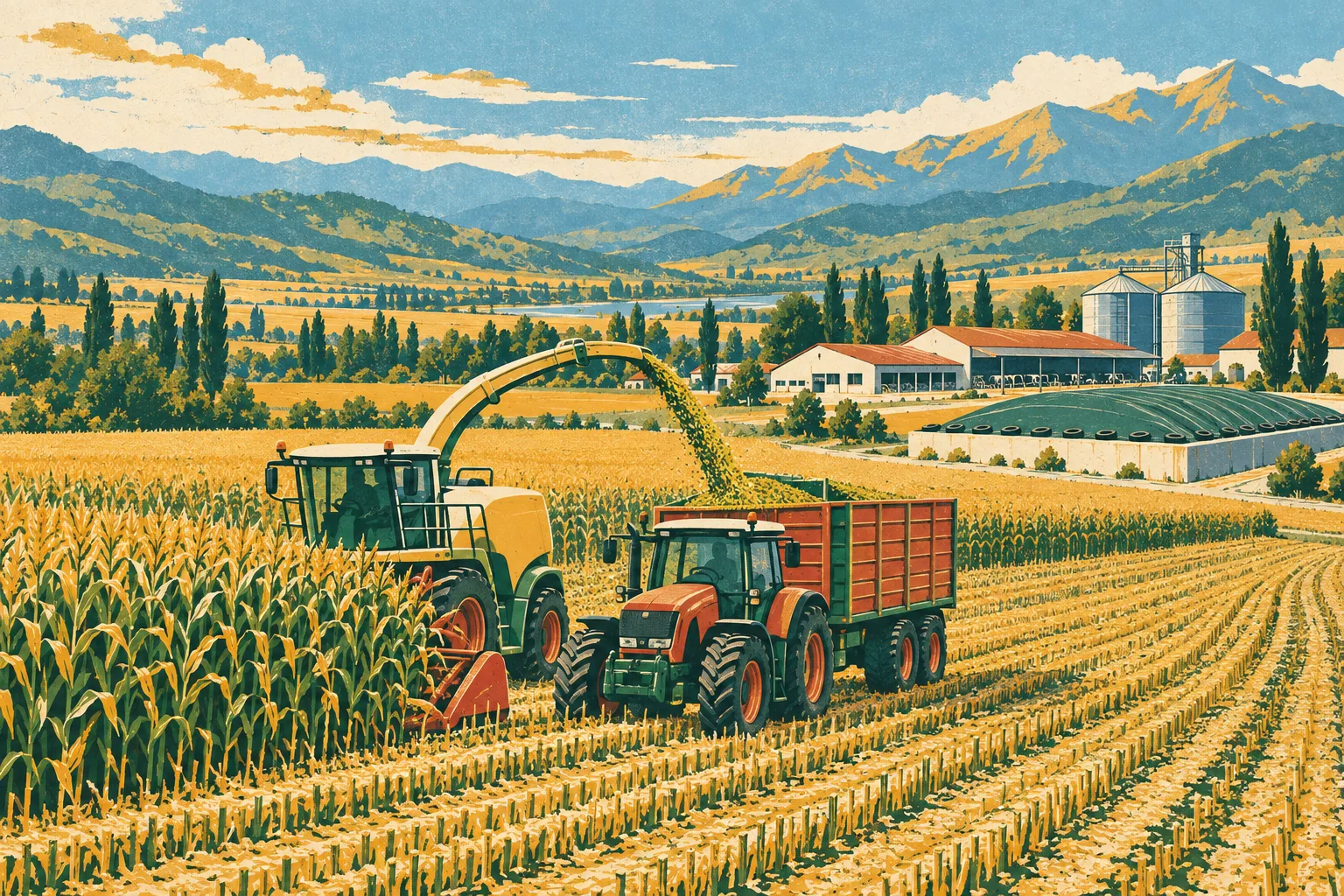
Competitive milk production requires reliable feed. Georgia already produces major dairy-feed crops including maize, and there is potential to organize crop production more systematically around the needs of commercial dairy farms.
The important opportunity is not simply crop volume. It is development of:
- 01Seed selection
- 02Crop production
- 03Irrigation
- 04Harvest timing
- 05Silage
- 06Grain storage / drying
- 07Quality testing
- 08Ration formulation
- 09Prepared feed distribution
Dairy Creates Businesses Around the Farm
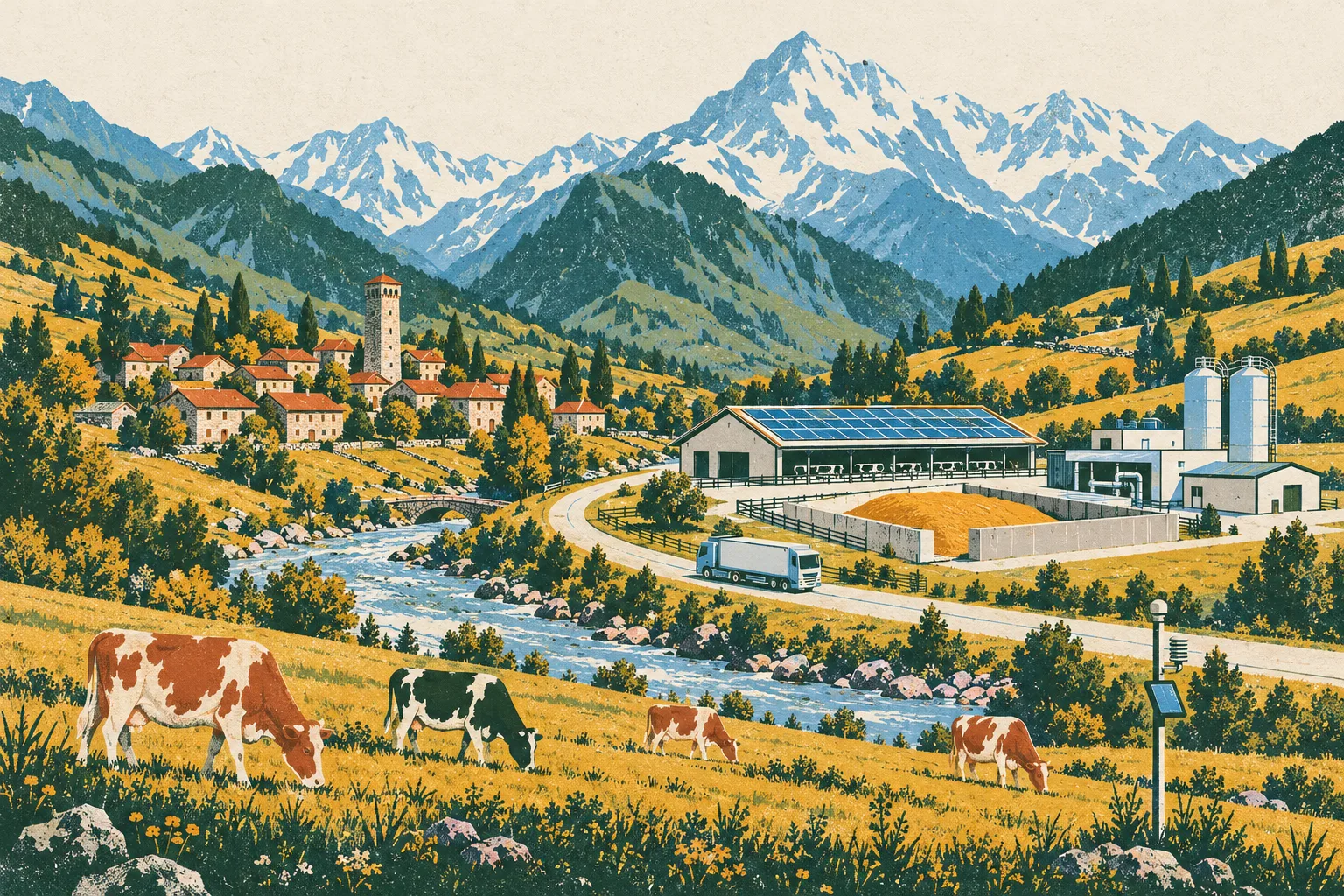
A modern dairy industry creates economic activity well beyond milk production itself.
Dairy development can create a network of rural enterprises, not merely farms.
 The farm
More Value Can Be Created After the Farm Gate
Raw milk creates greater economic value when it can be transformed into consistent, safe and marketable products. Georgia therefore has opportunities not only in dairy farming, but also in modern processing and product development.
- Drinking milk
- Yogurt and fermented dairy
- Traditional and modern cheeses
- Butter and cream
- Cultured products
- Specialty dairy
- Ingredient and by-product utilization

The opportunity is particularly strong where reliable raw-milk supply, product quality, packaging, cold chain and market positioning are developed together.
Turn on all five and the system moves.
Build on Tradition Without Being Limited by It
Georgia has long-standing dairy-food traditions, particularly around cheese and fermented products. These traditions create identity and market value.
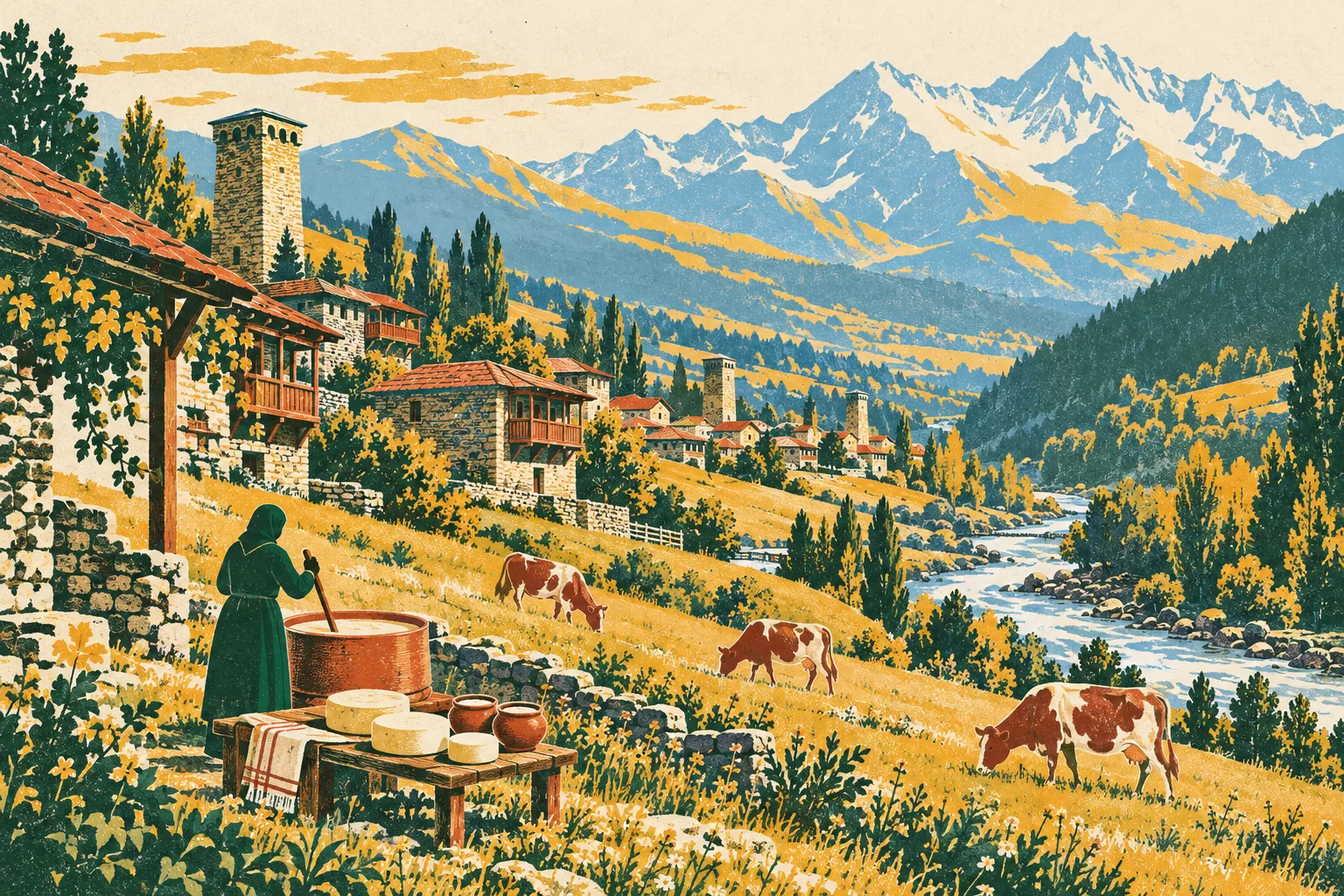
Modern dairy development does not require abandoning traditional products. It can instead strengthen them through:
Compete for More of the Domestic Market
Where domestic production can achieve competitive quality, consistency and economics, modern Georgian dairy businesses may have opportunities to replace part of the country’s reliance on imported dairy products.
The objective should not be import substitution at any cost. Local production must compete on quality, reliability, product fit and economics.
QualityReliabilityProduct fitEconomics
Imported dairyLocal production
From Domestic Competitiveness to Export Capability
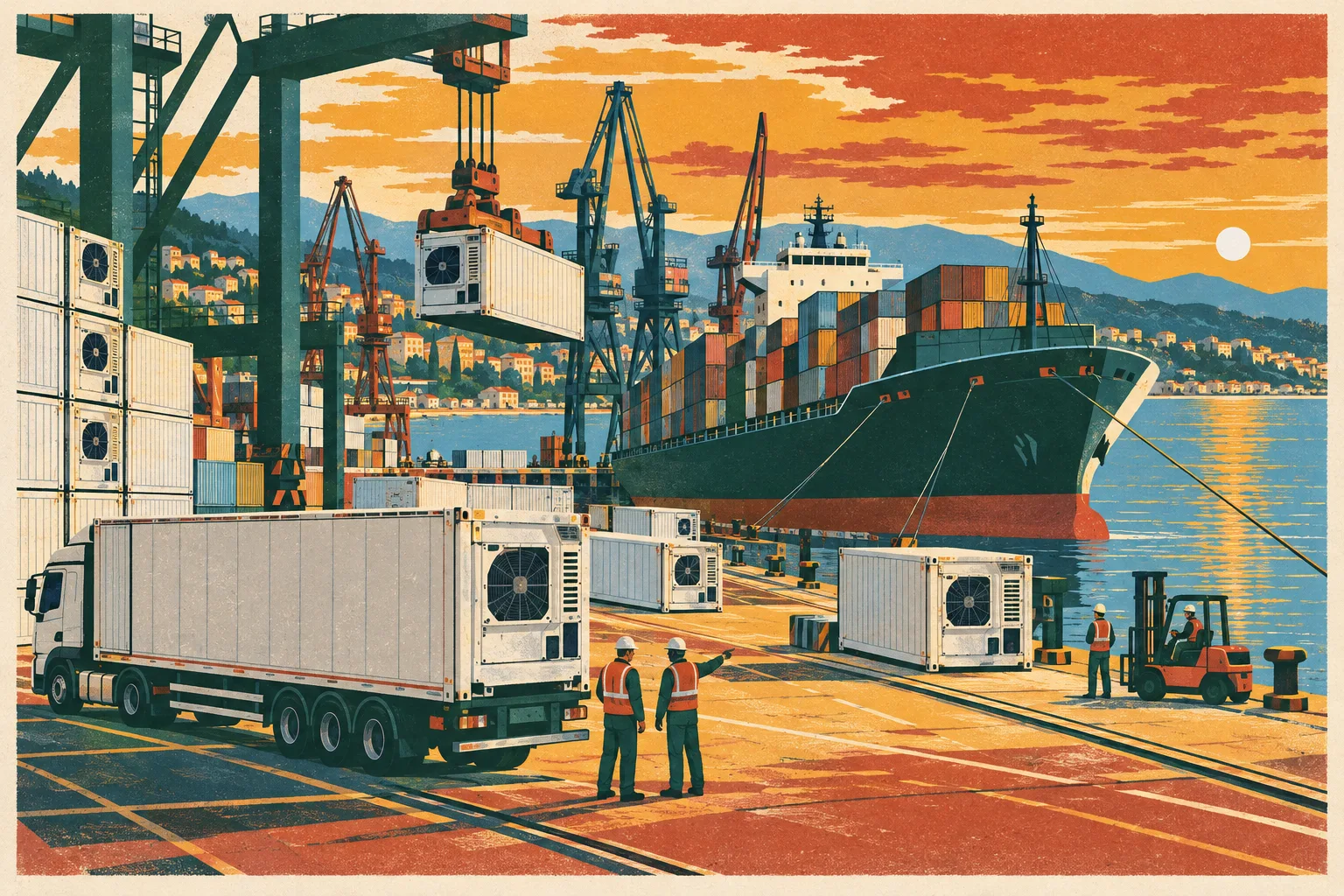
Georgia’s trade connections create potential export opportunities, but dairy exports require more than tariff access. Export readiness requires:
0of 11 in place
Export should be the result of a competitive dairy system, not a substitute for building one.
A Country Actively Seeking Business Development
Georgia maintains dedicated public institutions supporting entrepreneurship, exports and investment.
Enterprise Georgiaunder the Ministry of Economy and Sustainable Development
BusinessExportInvestment
Enterprise Georgia operates separate business, export and investment functions and acts as an interface for investors and business development.
Enterprise GeorgiaLarge Enough to Build. Small Enough to Coordinate.
Georgia’s size can be an advantage for developing integrated dairy systems. Farms, processors, service providers and markets can be connected nationally without the geographic complexity of very large countries.
This can make Georgia suitable for piloting standardized technical systems, digital platforms, distributed service models and coordinated production networks before adapting successful models elsewhere.
- Farms
- Processors
- Service providers
- Markets
Modernize Without Repeating Every Legacy Step
Parts of Georgia’s dairy sector remain relatively lightly digitized. This can be a disadvantage today, but it also creates an opportunity to introduce modern systems directly rather than layering new technology on top of decades of incompatible legacy infrastructure.
Illustrative paths.
Layer on legacy
Paper recordsSpreadsheetsIsolated softwarePatched interfacesIntegration projects
Each new tool patched onto the last.
Introduce directly
Herd managementMilk recordingIoTFeed managementTraceabilityLaboratory integrationLogisticsInventoryDigital paymentsFinanceMarketplace systemsAI-supported decision tools
Modern connected systemsOne platform; systems introduced directly.
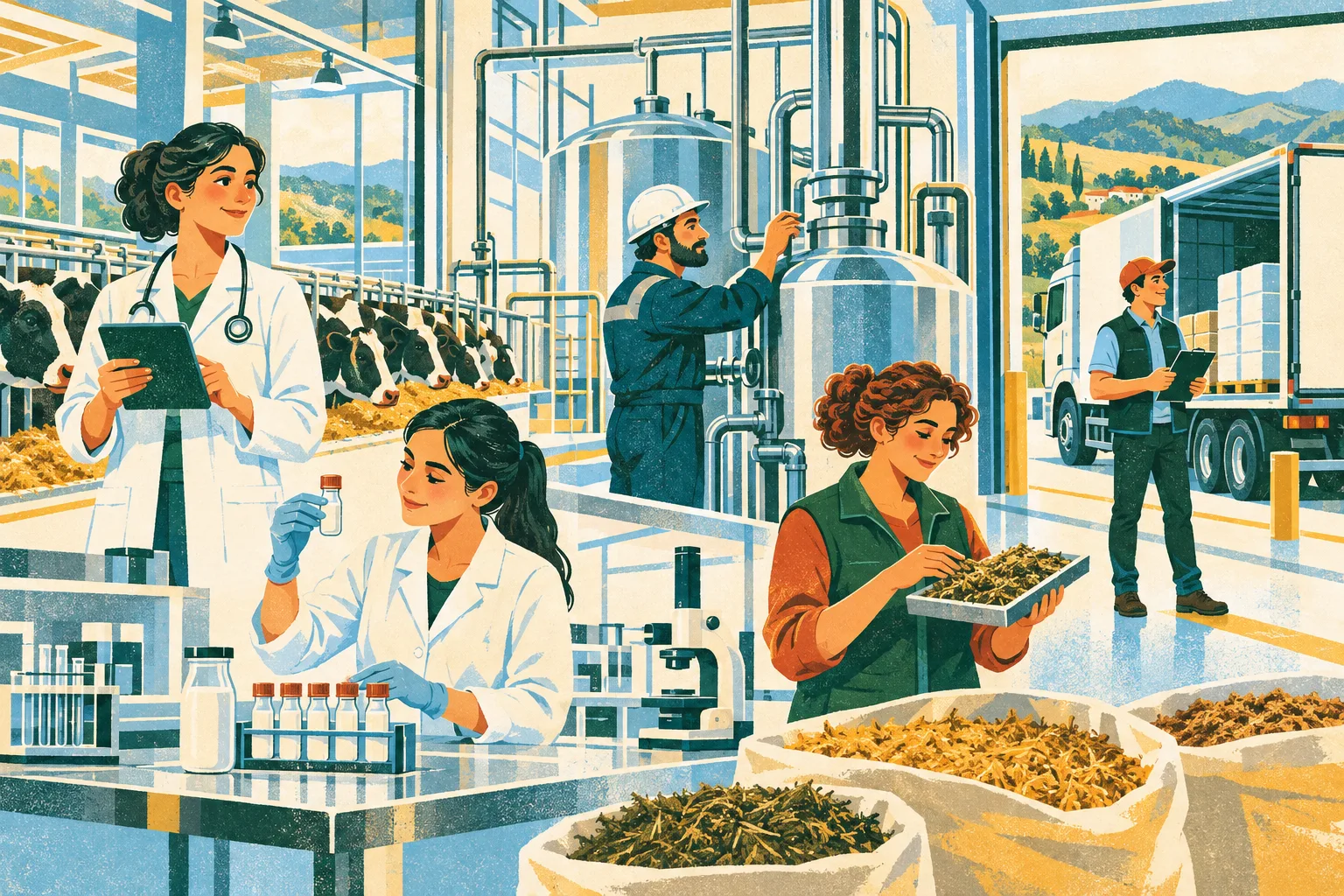
VeterinariansTechniciansNutrition specialistsEquipment operatorsEngineersLogistics staffLaboratory personnelQuality professionalsDigital-system usersManagers
Dairy Can Create More Than Traditional Farm Labor
A modern dairy value chain requires veterinarians, technicians, nutrition specialists, equipment operators, engineers, logistics staff, laboratory personnel, quality professionals, digital-system users and managers.
Predominantly manual agricultural laborTechnicalProfessionalEntrepreneurial
Modernization therefore creates an opportunity to transform dairy work from predominantly manual agricultural labor into a broader range of technical, professional and entrepreneurial roles.
Georgia Can Import Knowledge Without Importing Entire Business Models
Georgia can benefit from international dairy genetics, equipment, engineering, management systems and professional expertise. But systems developed for Canada, Western Europe or other large dairy economies cannot always be copied directly.
- Genetics
- Equipment
- Engineering
- Management systems
- Professional expertise

Farm sizeFinanceLaborClimateInfrastructureMarketsRural settlement patterns
GEO Dairy’s approachUse international knowledge.Design for Georgian reality.
A Country Suited to Distributed Dairy Development
Several characteristics make Georgia particularly relevant for the Dairy Grid concept: fragmented rural production, the need for productivity improvement, the potential for shared specialist services, geographically distributed communities, opportunities for modern feed and milk systems, and the possibility of connecting independent businesses through one digital and commercial network.
The objective is not to centralize every farm into one corporate operation. It is to create economies of scale around independent businesses rather than only inside a single large business.
Dairy Grid can combine
Where Investment Can Happen
- Commercial dairy farms
- Feed production
- Genetics
- Calf / heifer businesses
- Veterinary systems
- Milking and cooling
- Environmental systems
- Milk collection
- Processing
- Cheese plants
- Packaging
- Quality laboratories
- Wastewater and utilities
- Cold storage
- Refrigerated transport
- Distribution
- Retail
- E-commerce
- Export channels
And around all threeService·Equipment·Inputs·Finance·Workforce·Technology
Why Georgia Also Requires Careful Project Design
Georgia offers dairy opportunities precisely because parts of the value chain remain underdeveloped. Investors and operators should therefore evaluate constraints as seriously as opportunities. Potential challenges include:
The right question is not simply “Is Georgia attractive?” but “Which dairy business model is appropriate for Georgia, in which region, at what scale, and with which supporting capabilities?”
Turning Opportunity Into a Defined Dairy Project
GEO Dairy was created to help connect the pieces required to develop dairy businesses in Georgia.
Considering a Dairy Opportunity in Georgia?
A dairy opportunity may begin with a farm, a processing plant, a feed business, a cold-storage facility, a distribution network, a technology solution or an investment thesis. The right pathway depends on the business, location, scale and project stage.
01Businessto define02Locationto define03Scaleto define04Project stageto define
Explore Georgia
- Business EnvironmentHow companies, investors and projects operate.
- Dairy LandscapeThe structure, production and development of Georgia’s dairy industry.
- Regions of GeorgiaRegional agricultural and investment characteristics.In preparation
- Invest in GeorgiaHow dairy investment opportunities can be developed.

A Dairy Industry With Room to Build
Georgia already has dairy production, dairy traditions, agricultural resources, processors, markets and international connections. What remains is to strengthen the professional systems linking them.
For GEO Dairy, that gap is the opportunity: to build more productive farms, stronger processing, better supply systems, professional services, skilled businesses and more connected markets around a modern Georgian dairy industry.